

A perpetual dearth of affordable retail space within Boston proper has more users targeting secondary and tertiary markets as they look to penetrate the greater New England region.
Ask a local retail broker or landlord to name tenants that are currently expanding aggressively in the greater Boston area and throughout New England as a whole, and odds are that “Ross Dress for Less” will come up within the first minute.
Of course, the California-based discount retailer has been crushing it for some time now. Ross announced in mid-March that it had opened 17 new stores, including four under its dd’s Discounts brands, in the first quarter — openings that followed the rollout of 36 new stores last fall. According to USA Today, these new stores came as part of Ross’ broader plan to grow its store count by about 200 units over the course of 2025 and 2026.
These new store openings included locations in New York and New Jersey, but at the time, that appeared to be the northbound extent of the expansion. Not surprising, given that the discount apparel market in New England has long been dominated by TJX Cos., the metro Boston-based parent company of both T.J. Maxx and Marshalls, with Burlington also routinely capturing a respectable share of that market.
The fact that Boston proper was — and still is — largely devoid of vacant boxes that could meet the spatial requirements of a user like Ross further allayed any concerns that a meaningful push by a major discount retailer into that market was forthcoming.
And indeed, Ross has not announced plans for any new stores in the city of Boston. The company is, however, aggressively targeting suburban Massachusetts and Connecticut. And sources say that this pattern is also applicable to other soft-goods merchandisers, as well as food-and-beverage (F&B)
users that simply cannot afford rents in downtown Boston, Back Bay, the Seaport District or Cambridge’s Harvard Square but want to be in the market.
Whereas many tenants have predicated their Northeast expansionary campaigns on planting flagship stores or restaurants in top-tier markets — New York City is a necessary evil for branding purposes — the opposite approach may be more sensible for Boston and New England.
“Because New York City is so important as the financial and economic center of the country, there’s so much power in building a brand there, so retailers may do deals there just to get their names out,” says Ben Starr, partner at regional brokerage firm Atlantic Retail Partners. “In Boston, prominent spaces in Back Bay or the Seaport can be meaningful to retailers that want to say they’ve arrived and planted a flag.”
“But a lot of those groups are already established in New York City, so the brand recognition [factor] may not be as important as making money on the new stores in Boston,” Starr continues. “So we actually see retailers coming into this market to take a more affordable route and do a suburban deal first, then go urban, rather than the other way around.”
Starr adds that he also sees new tenants flocking to secondary or tertiary markets that, despite having urban centers, still have rents that are very affordable compared to Boston, as well as less strict regulatory environments. He identifies cities such as Groton, Connecticut; Bennington, Vermont; Palmer, Massachusetts; Saco, Maine; and Pittsfield, Massachusetts as examples of such markets.
“Tenants have had success in those markets and are willing to take more risk in areas where real estate is more affordable and easier to find and doesn’t require record-setting sales [to be able to afford rents],” Starr says.
Tim McNamara, senior director in Cushman & Wakefield’s Connecticut office, says it’s more common for new-to-market retailers to target the region as a whole without specifically mandating a store in a premier submarket.
“If retailers happen to get a downtown store, that’s great, but that means dealing with a lack of parking and high-priced space, and they don’t have the ability to grow beyond a certain threshold in that area,” McNamara explains. “So some retailers have decided that downtown Boston doesn’t make the most long-term sense for them.”
“From a price perspective, retailers are also realizing that for flagship-type locations they’ve had in which visibility is very high, the juice may not be worth the squeeze in terms of paying that much rent just to have that one footprint,” McNamara adds. “Instead, they can have multiple locations in the suburbs that will grow more substantially.”
As native New Englanders, Starr and McNamara have both observed a demographic tendency in the region — that all factors being held equal, people prefer to be close to the city and don’t branch out to suburbs as aggressively as they do in other large metro areas. That pattern is likely shifting to some degree as multifamily rents and single-family home prices in the immediate Boston area surge along with the rest of the country.
But that demographic trend also helps partially explain why — along with myriad other factors ranging from zoning to geography to preservation of historic buildings — new retail development in suburban New England is relatively muted.
Landlord Perspective
While sources cite varying explanations behind the dearth of retail supply growth in the region, they agree that the demand, rooftops and disposable incomes that retailers need to be successful in these markets are all there.
“The suburbs are definitely having a moment,” confirms Adriana Major, senior leasing representative at Linear Retail, a regional owner-operator. “Retailers are increasingly recognizing that the suburbs are where many consumers are working, living and generally spending more time. Convenience has become one of the biggest drivers of retail success, and well-located neighborhood shopping centers allow brands to meet customers where they’re already going for groceries, fitness, healthcare and everyday errands.”
“That strategy is reflected across our portfolio,” she continues. “Specialty fitness concepts such as JETSET Pilates in Wellesley and Club Pilates in North Andover are choosing suburban locations to be part of residents’ everyday routines. Wellness and beauty brands, including VIO Med Spa in Burlington and upcoming locations for Glowbar and Mona Dermatology in Wellesley, are following a similar path. These retailers recognize that being conveniently located where people live, work and run daily errands creates meaningful opportunities for repeat visits and long-term customer loyalty.”
Major believes these trends were set in motion during the COVID-19 pandemic and have been extended by a slower-than-expected return to office buildings.
“The strength of these markets post-COVID has continued to rise; COVID didn’t shut them down, but rather made people want to get out more, and market performances have been on the up and up since then,” she concludes. “We’re excited to be expanding within the suburbs of Boston, which are very strong markets for us.”
Major is particularly bullish on markets in southern New Hampshire, where she sees opportunities to push rents, partially because the Granite State has no income tax. In addition to being a “destination” market in terms of retail, the appeal of southern New Hampshire is also bolstered by the fact that it’s a sensible landing spot for people who work in Boston but cannot comfortably afford to live there, Major says.
Dan Zelson, principal at Charter Realty/Zelco Properties & Development, agrees that the retail acceleration in suburban New England originated with the pandemic but has now become fully self-sustaining, fueled in part by the steady lack of supply growth. Zelson, whose company is especially active in Connecticut, says that rents in many of these markets are “catching up pretty quickly” to those of Boston.
“Fairfield County is on fire right now,” Zelson asserts. “It’s very hard to find space in markets like Westport, Darien and Greenwich, and so much money has come into the suburbs that many consumers who used to be in New York City or Boston are now spending their money there. Retailers have figured that out. And with almost no new product, rents are being driven through the roof, but retailers are paying those rents because the volumes are there.”
Zelson provides some numbers to support this analysis.
“We have a project in Belmont, Massachusetts, for which we’re getting rents in the $60 [per square foot] range, whereas historically, those rents were in the $30s,” he says. “We also have a Whole Foods-anchored center we just completed in Cheshire, Connecticut — a market that was previously getting about $25 [per square foot] for shop space. Those rents are now in the mid-$50s to $70s for pad sites.”
“In Stamford, Connecticut, where we just bought a deal, we’re seeing shop-space rents in the $80s and $90s [per square foot],” Zelson continues. “The downtown areas of Greenwich and Westport have spaces that are pushing $150 to $200 per square foot; Main Street in Westport is $120 to $140. Those are rents you see in New York City metros and that haven’t been seen in the suburbs.”
Zelson concedes that this pace of rent growth is crowding mom-and-pop operators out of the market, especially those that are true startups. But landlords have their own exorbitant costs to worry about, and tenants seem to be understanding of that, especially those with hefty build-out visions and plans.
“Retailers have figured out that it’s so expensive to build that they almost have no choice but to give developers decent rents if they want [to secure allowances] to build out their spaces,” Zelson explains.
Mall Action
Other landlords express similar sentiments about the region’s suburban retail potential.
“Great demographics [in suburban submarkets] create opportunity, but they don’t guarantee success. The real expertise lies in uncovering connective opportunities and assembling the right environment and tenant mix, thus setting the stage for retailers to succeed,” says Tom Wilder, principal at Wilder, a regional owner-operator specializing in retail real estate repositioning.
“The centers that win today are the ones that give people multiple reasons to visit repeatedly, whether that’s shopping, dining, entertainment or community events. Our focus is always on building that value within the ecosystem and merchandising a tenant mix that enables retailers to thrive.”
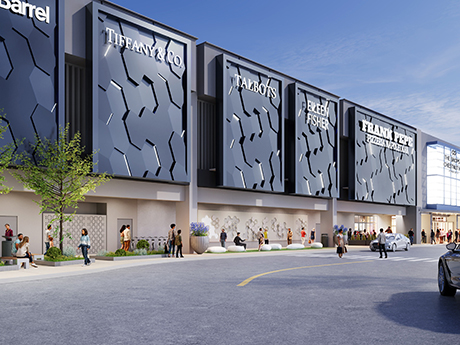
Wilder has focused considerable energy over the past three years on the ground-up reimagining of the former Walpole Mall in Massachusetts.
“The property has evolved well beyond its traditional interior mall roots into a vibrant open-air destination,” Wilder says. “The rebrand to The Link at Walpole served as the final piece of that transformation, reflecting its role as a place that brings people, retailers and experiences together. By thoughtfully shaping the environment and tenant mix, we’ve transformed the property into a destination that remains active throughout the week and is deeply connected to the surrounding community.”
As part of the remerchandising process, the company built a brand new Chick-fil-A outparcel, backfilled a former JoAnn’s store with a Burlington outlet, added a 41,000-square-foot FunCity entertainment venue, relocated some existing retailers/services into upgraded spaces and introduced a host of new F&B concepts. In addition, Wilder has incorporated open green spaces for social events and gatherings, a feature that is something of a staple at most of the company’s properties.
“Our goal is never simply to renovate a shopping center,” Wilder says. “It’s about building a place that’s woven into the community it serves. In a market like Walpole, that means bringing together the right mix of uses and experiences to give people reasons to return again and again.”
Other mall or power center redevelopments throughout the region tell a similar story: an exceptional piece of real estate, healthy, family-oriented surrounding demographics, demand from both tenants and consumers for new concepts — all just waiting to be brought together.
Few owners have capitalized on those opportunities as well as Simon Property Group. According to Laura Schwartz, Simon’s senior vice president of leasing, the company isn’t so much focused on specific retailers as it is categories that routinely perform well with New England consumers. She cites athletic and outdoor apparel, footwear, beauty and experiential retail as core examples of these categories and notes that “premium lifestyle concepts are gaining ground alongside them.”
“That momentum tells us something about where consumers in this region are putting their time and spending,” Schwartz adds. “Today’s shoppers are more connected and informed than ever, but they still value the in-person experience and continue to be drawn to brands with authenticity and strong identities. The retailers seeing the strongest results are the ones combining a strong product offering with a genuine connection to their customers, which is what positions them for growth in this market.”
Among Simon’s latest such revitalization projects in New England are:
- Summer debuts of new retail and restaurant users — Shaquille O’Neal’s Big Chicken, bubble tea concept Gong Cha, athletic apparel brand Fabletics and children’s retailer Gymboree — at Wrentham Premium Outlets, an open-air power center in southern Massachusetts
- Openings of stores for new-to-market retailers — jeweler Gorjana, athleisure retailer lululemon and activewear brand OFFLINE by Aerie — at the 1 million-square-foot Mall at Rockingham Park in Salem, New Hampshire, where a 160,000-square-foot casino is also slated to open next year
- Completion of the redevelopment of Shops at Chestnut Hill, an enclosed mall located on the western outskirts of Boston
Prior to those endeavors, Simon also redeveloped Northshore Mall, located north of Boston in Peabody, in 2025. The Indianapolis-based owner-operator brought in new, experiential anchors such as a Dick’s Sporting Goods ‘House of Sport’ store, Golf Lounge 18, Gametime Lanes & Entertainment, Immersive Gamebox and LifeTime Fitness. Prior to that in 2025, Simon revamped the tenant roster at Burlington Mall, also located north of Boston, with an array of new merchandisers and F&B users.
This article was originally published in the July 2026 issue of Shopping Center Business magazine.