

Florida’s focus on providing a friendly business and regulatory climate alongside its white sand beaches continues to fuel the state’s rising economic fortunes.
Since 2022, Florida’s population has increased by more than one million, and job growth over the last five years has reached double digits in each of its five major markets, ranging from nearly 11 percent in Jacksonville to 18.3 percent in Orlando, reports SRS Real Estate Partners, a national commercial real estate advisory firm that has multiple offices throughout the state. Those dynamics are helping to drive a retail juggernaut as expansion-minded operators across all categories continue to seek space in the markets, none of which has an average vacancy of more than 5 percent.
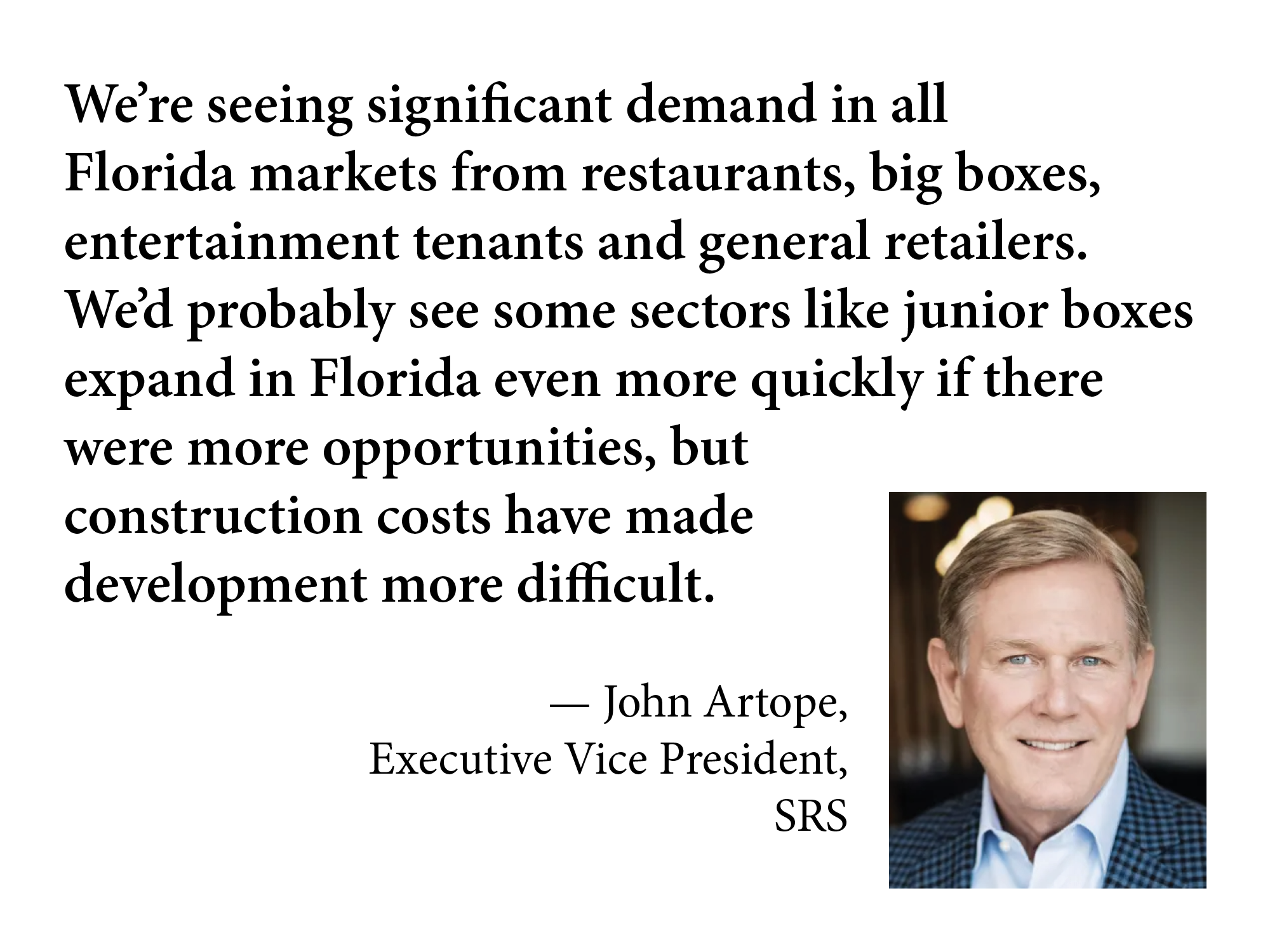
“We’re seeing significant demand in all Florida markets from restaurants, big boxes, entertainment tenants and general retailers,” says John Artope, an executive vice president and managing principal of SRS Real Estate’s Orlando and Tampa offices. “We’d probably see some sectors like junior boxes expand in Florida even more quickly if there were more opportunities, but construction costs have made development more difficult.”
That’s not to say development is nowhere to be found. With 2.6 million square feet of retail space under construction, the Tampa metro boasts the deepest development pipeline in the state. Residential growth in Pasco County to the north is driving much of the activity, and notable projects include 500,000 square feet of retail being built in the Double Branch master-planned community. In Tampa proper, Simon Property Group is adding 50,000 square feet of open-air space to luxury shopping destination International Plaza as part of a broader strategy to reinvest in high-growth markets.
Meanwhile, projects in Orlando range from the recent opening of the 405,000-square-foot Lake Nona West, anchored by Target, to a planned 40-acre power center in nearby St. Cloud, anchored by a Walmart Supercenter. “The Florida economy has been driving migration to the state for a long time, and it’s not slowing down,” says Artope, who works with regional and national tenants. “Retailers and developers are following that migration.”
Capital Finds a Home
Florida also remains an active hunting ground for investors, says Patrick Nutt, senior managing principal and co-head of national net lease for SRS. He expects the firm to facilitate more than a thousand retail transactions valued at roughly $4 billion this year across the country. Assets in Florida are among the most sought after amid tenant expansions, residential growth and a high rate of discretionary income. Those dynamics help drive rent increases and mitigate the risk of a prolonged vacancy, which is appealing to entrepreneurs diversifying their investments, 1031 exchange buyers seeking safe havens and institutional investors rotating into retail assets after years of avoiding them, he adds.
“There’s no shortage of wealth migrating to Florida, whether it’s people and businesses fleeing New York’s high taxes and regulations or people retiring,” declares Nutt, who is based in Tampa. “We’re also seeing job and wealth creation spread outside the most-talked-about cities in South Florida, like Miami and Palm Beach, to the other major markets of Tampa, Orlando and Jacksonville.”
Investor demand focused on Florida can best be highlighted through recent transactions SRS Capital Markets arranged, like the sale of a Taco Bell in Orlando operated by a mid-sized franchisee that received 14 offers, Nutt says, or a newly constructed Texas Roadhouse that received 11 competing offers. Given the volatile interest rate environment, similar assets in the national marketplace generate about three offers at most unless they’re located in high-growth markets, he points out.
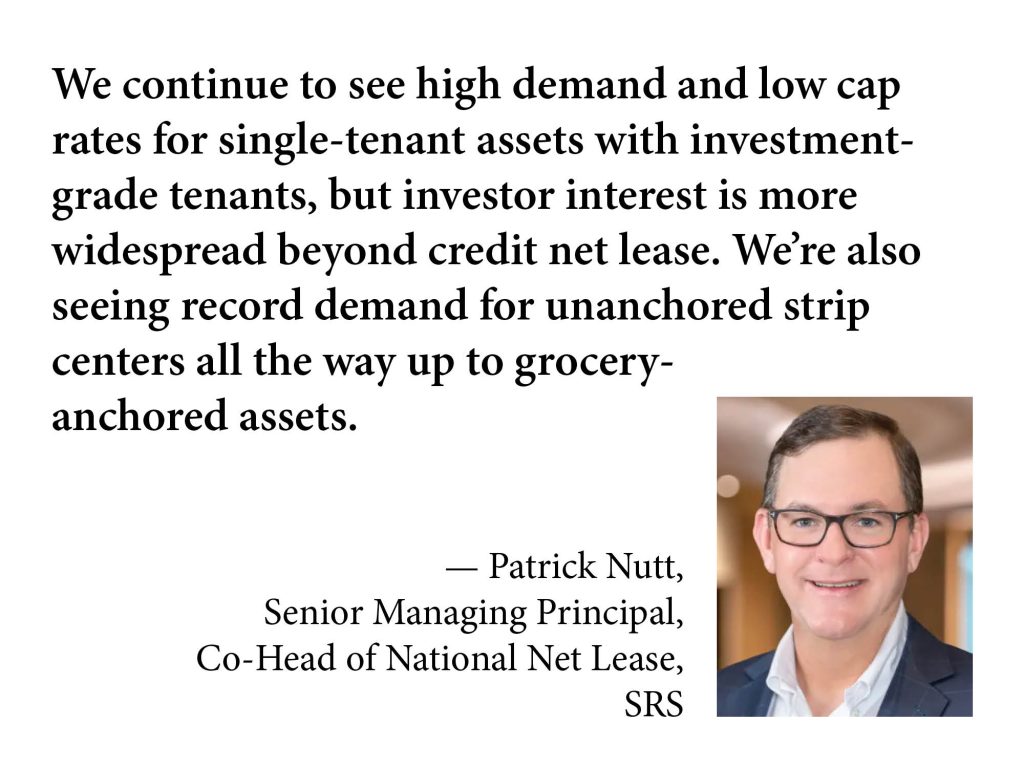
“We continue to see high demand and low cap rates for single-tenant assets with investment-grade tenants, but investor interest is more widespread beyond credit net lease,” he explains. “We’re also seeing record demand for unanchored strip centers all the way up to grocery-anchored assets.”
Locking in the Next Hot Spot
Even secondary and tertiary markets in Florida’s panhandle like Tallahassee and Pensacola are witnessing strong investor interest, Nutt adds. Developers, too, are piling into smaller markets. Over the last few years, for example, Target and Walmart-anchored projects have brought Aldi, Texas Roadhouse, Starbucks and a host of other users to the small town of Lecanto in Citrus County. Sprouts Farmers Market, Ulta Beauty and Five Below are among tenants opening in a new development nearing completion, and BJ’s Wholesale Club recently broke ground on a new store in Lecanto.
“Lecanto is in the path of growth,” Artope says. “It’s getting attention from tenants like Target and BJ’s, and the next thing you know, it’s getting attention from all the users that want to be around those anchors.”
Looking ahead, Nutt and Artope note that a potential hike to the federal funds rate by the Federal Reserve this year could dampen real estate investment and slow plans for store expansions. But even with today’s elevated cost of capital relative to a few years ago, investors and retailers in Florida have remained as active as ever, they add.
“Retail is in a very good place in Florida,” Nutt says. “I don’t see that changing anytime soon for a variety of reasons, including Florida’s pro-business and tax-friendly environment. Capital will continue to flow into our state.”
— By Joe Gose. This article was written in conjunction with SRS, a content partner of Shopping Center Business.
SRS Real Estate will explore these Florida-specific topics and more at the upcoming ICSC@Florida conference, August 31 – September 1. Visit them at booth 2905 in the Orange County Convention Center.
About SRS Real Estate Partners
Founded in 1986, SRS Real Estate Partners is celebrating 40 years of going the extra mile for its clients. A leader in consumer-driven real estate, SRS provides commercial real estate solutions across retail, industrial, and capital markets. Headquartered in Dallas with 30 offices nationwide, the firm measures its success by the achievement of its clients’ objectives, satisfaction, and trust. For more information, please visit srsre.com.