

Western U.S. retail markets continue to witness flourishing leasing and investment activity. As in other parts of the country, the primary challenge for retailers and investors alike is finding supply to meet the demand, say SRS Real Estate Partners experts Scott Ellsworth and Gary Chou.
In Arizona, Taiwan Semiconductor Manufacturing Company’s $265 billion investment to build six fabrication plants along with packaging and research and development facilities in the Phoenix market is driving economic activity and contributing to population growth. It also has effectively added a sixth “c” – chips – to the state’s traditional economic drivers of copper, cattle, cotton, citrus and climate, says Ellsworth, a senior vice president and principal of SRS based in Phoenix. The semiconductor industry’s continued expansion also reinforces Arizona’s business-friendly climate, which helped attract new companies and residents during the pandemic.
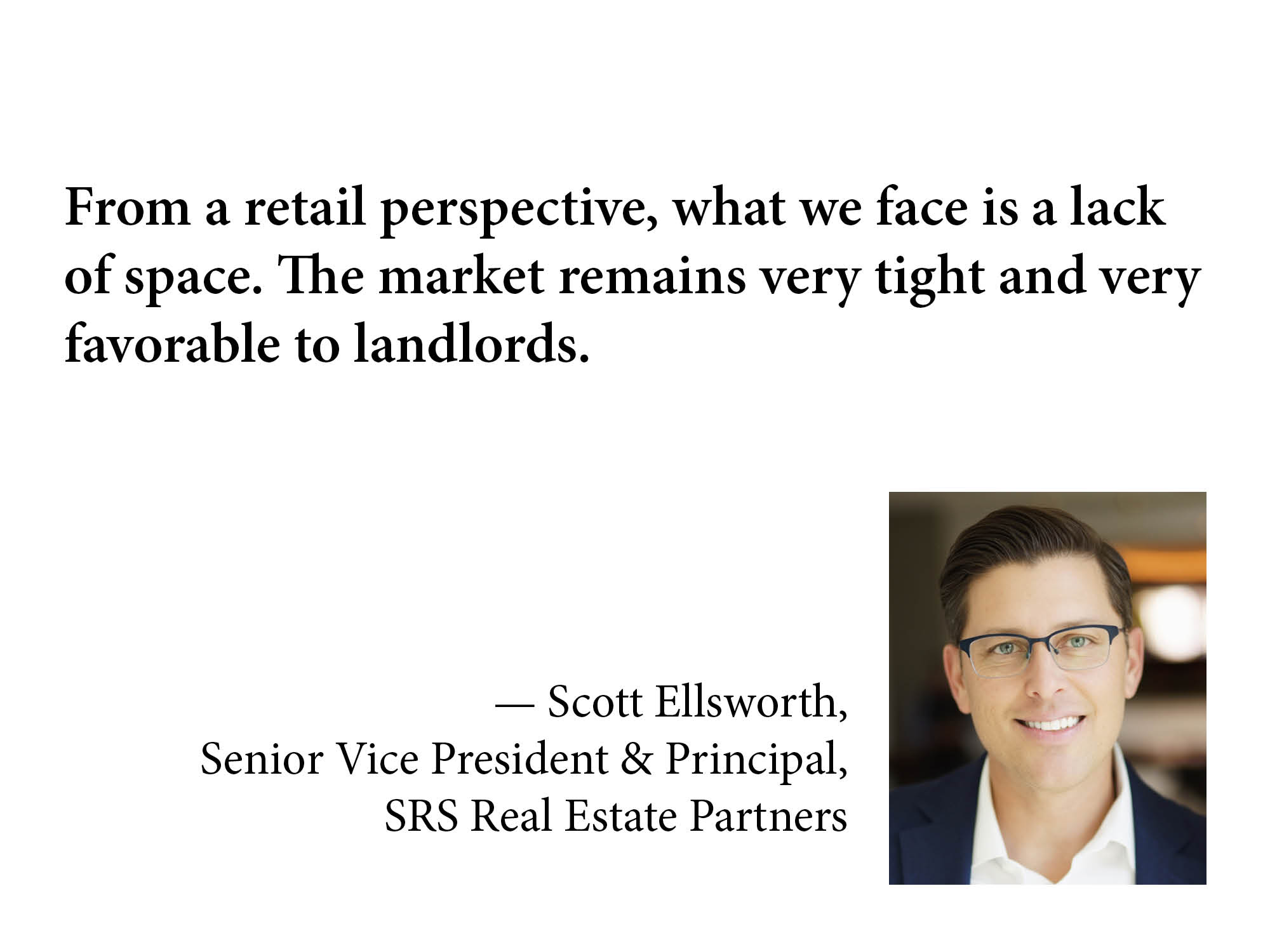
“Our population growth has always been one of the biggest stories,” adds Ellsworth, who represents tenants and landlords in lease negotiations. “But from a retail perspective, what we face is a lack of space. The market remains very tight and very favorable to landlords.”
Strategic Choices
Ellsworth reports that the metro’s shopping center vacancy rate has been below 5 percent for several quarters. New construction remains severely muted compared with annual completions of around 10 million square feet 15 to 20 years ago, he adds, and space provided in the market by the closings of JoAnn Stores, Big Lots and Party City locations has offered only temporary relief.
“Many of those boxes are in portfolios that we represent, and they have been leased up,” Ellsworth says. “Phoenix is definitely on the radars of a lot of retailers for expansion, so it remains an extremely competitive market.”
Typically, retailers want to tap into the density in the metro’s core first and then grow their footprint outward. But in the current environment, many must decide whether to wait for openings in the preferred denser areas or expand in growing peripheral submarkets first, he observes.
Some of those opportunities are popping up in communities like Buckeye on the west edge of Phoenix. A retail corridor is taking shape around the Interstate 10 and Verrado Way intersection, for example, where Vestar recently opened Verrado Marketplace, a 500,000-square-foot project anchored by Target, Safeway and Harkins Backlot. A Costco and Home Depot are slated for a center under development across the freeway.
“A lot of the new retail construction is occurring in these tertiary submarkets,” Ellsworth explains. “And developers are not having difficulty leasing up the projects.”
Split Fortunes in SoCal
Southern California retail dynamics are a bit different, notes Gary Chou, executive vice president and managing principal at SRS, who is based in Newport Beach. While the region is seeing similar robust leasing activity in Orange County and in the growing Central Valley, the departure of residents from urban areas in and around Los Angeles during the pandemic has contributed to elevated vacancies, he points out.
From a capital markets perspective, however, Southern California remains in demand, albeit with caveats. Buyers that prefer new properties are likely to find more of those opportunities in the Inland Empire and High Desert communities. In some cases, they’re looking for deals in Arizona and other Mountain states experiencing robust population growth, adds Chou, who focuses on net-lease, sale-leasebacks, merchant developer representation and other investments.
Institutional investors, private groups and family offices are primarily trading existing assets, including grocery-anchored, net-lease and mixed-use properties. Large assets and single-tenant properties with highly coveted tenants like Chick-fil-A or Raising Cane’s are typically fetching capitalization rates of between 4 and 5 percent, and, in some cases, sub-4 percent.
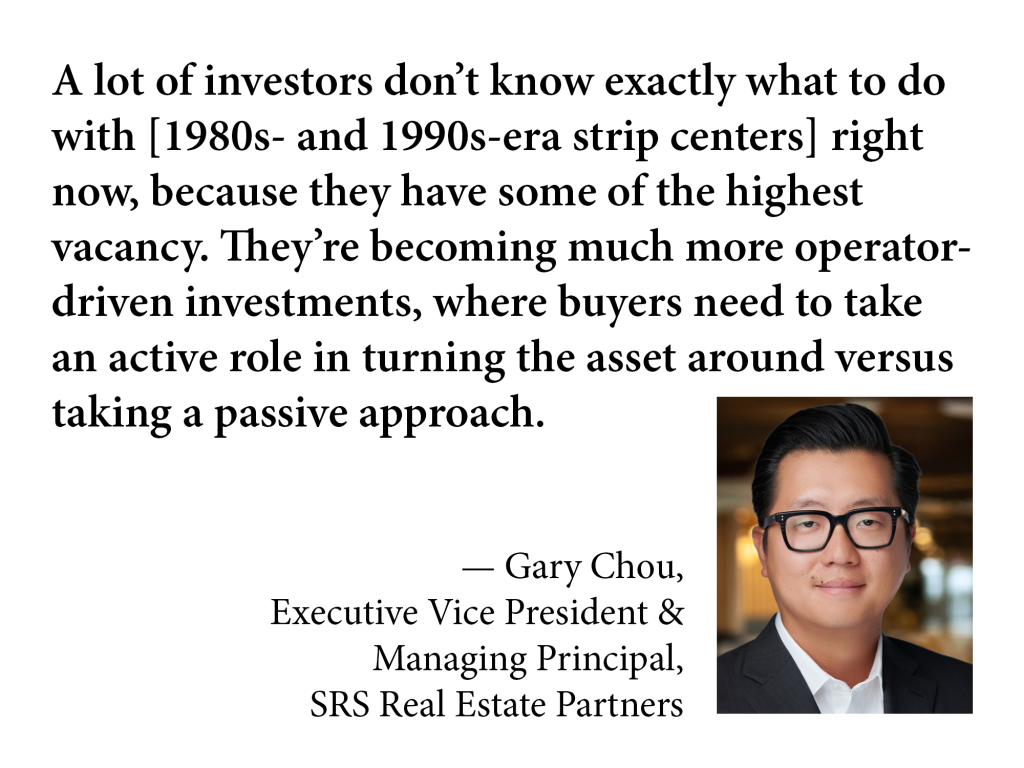
Meanwhile, 1980s and 1990s-era strip centers are generally trading at higher cap rates, as are mixed-use projects with offices, Chou explains. Each tends to have their own set of challenges. “A lot of investors don’t know exactly what to do with those types of properties right now, because they have some of the highest vacancy,” he says. “They’re becoming much more operator-driven investments, where buyers need to take an active role in turning the asset around versus taking a passive approach.”
Still, California investment sales volume is on a pace that should exceed 2025 by 25 to 30 percent, he conjectures. But that could change given the recent volatility in the bond market. As of mid-September, the benchmark U.S. 10-Year Treasury yield was bouncing above and below 5 percent, a full percentage point higher than a year earlier, amid Middle East turmoil that is driving oil prices and inflation higher.
“If we’d had a conversation about investment at this time last year, we were optimistic about rates, and that was reflected in investment activity at the end of 2025 and early this year,” Chou adds. “We saw some buyers pause in the second quarter. But so far this year, the appetite of most investors has remained consistent, and they’re pushing forward on deals.”
— By Joe Gose. This article was written in conjunction with SRS, a content partner of Shopping Center Business.
About SRS Real Estate Partners
Founded in 1986, SRS Real Estate Partners is celebrating 40 years of going the extra mile for its clients. A leader in consumer-driven real estate, SRS provides commercial real estate solutions across retail, industrial, and capital markets. Headquartered in Dallas with 30 offices nationwide, the firm measures its success by the achievement of its clients’ objectives, satisfaction, and trust. For more information, please visit srsre.com.