

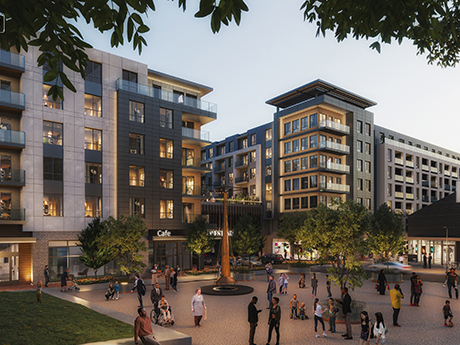
One of the nation’s consistently healthy retail markets is seeing a selective approach to growth.
Retail real estate across the Mid-Atlantic is having a moment — but it’s a disciplined one. As fundamentals remain healthy in Virginia, Maryland and Washington, D.C., the region is seeing a notably more selective approach to retail growth. Years of limited new development, zoning constraints and rising construction costs have tightened supply, pushing owners, investors and municipalities to be far more intentional about what gets built — and where.
Sources interviewed for this article point to the sustained demand for well-located shopping centers, such as those anchored by strong tenants, daily-needs retailers and dense surrounding populations.
“Retail today is about durability,” states Mike Castellitto, chief operating officer of Broad Reach Retail Partners. “Assets that serve essential, repeat-use visitors continue to outperform and attract both tenants and investors.”
Shifting Consumer Preferences
From Washington, D.C.’s dense suburban corridors to fast-growing secondary markets, Virginia’s retail real estate landscape remains one of the Mid-Atlantic’s steadiest performers.
The commonwealth’s strongest retail fundamentals are often seen in Northern Virginia, Hampton Roads and Richmond, where household income growth and population density create robust demand.
Jim Ashby, senior vice president of the Retail Services Group at Cushman & Wakefield | Thalhimer, states that greater Richmond is experiencing stable growth. The area has approximately 81 million square feet of total retail inventory.
“Limited supply is leading to a lot of demand, which is parlaying into new retail development projects being built,” says Ashby.
The Diamond District, a $2.4 billion mixed-use redevelopment project in Richmond, is transforming 67 acres of industrial land into a new, walkable neighborhood. The Richmond Flying Squirrels’ new Minor League Baseball stadium, CarMax Park, anchors the destination, which will also feature 2,800 residential units, 195,000 square feet of retail space, more than 1 million square feet of office space and a 180-room hotel.
Ashby says that the one issue facing the Richmond market is its success, which allows landlords to get a little more aggressive on rents. Asking rents are currently ranging from $42 to $55 per square foot in the Richmond market.
“We used to see anywhere from 2 to 3 percent for annual escalations on rent, and now many of the REITs I work with are pushing 3.5 to 4 percent,” says Ashby. “There are some retailers that, unfortunately, are hamstrung in that they have nowhere to go and nowhere to relocate, so the landlords have the upper hand.”
Retail vacancy in Virginia broadly remains below the national average, which is currently holding around 5 percent, according to research from CBRE. Specifically, Cushman & Wakefield reports that retail vacancy across key Virginia submarkets stayed tight in the third quarter of 2025, as Hampton Roads posted a vacancy rate near 3.9 percent, while Richmond’s retail vacancy hovered around 4.4 percent. Neighborhood and small-format retail have held even tighter compared to large-format big-box spaces.
In today’s market, Virginia’s retail landscape has consistently reflected the broader national shift from traditional retail to necessity-based and experiential uses. But while retail centers are progressively incorporating consumer preferences that cannot be replicated online, it’s no secret that high construction, financing and operating costs are significantly disrupting new retail real estate development and accelerating a shift toward redevelopment.
Midtown 64 is a major mixed-use redevelopment underway in Henrico County, just outside downtown Richmond. Spearheaded by Greenberg Gibbons, the $500 million project is a repositioning of the former Genworth Financial campus that spans 46 acres and consists of 130,000 square feet of retail and restaurant space, as well as 1,000 apartments, 194 townhomes, up to 300,000 square feet of office space and a 226-room dual-branded hotel. The first components of Midtown 64 are expected to open in early 2028.
Rising interest rates have made financing ground-up projects more expensive and riskier, while higher costs for labor, materials and permitting have squeezed project margins and made it harder for developers to achieve acceptable returns.
Nathan Shor, senior vice president of S.L. Nusbaum Realty, recounts that the shortage of quality sites, site development costs and construction costs are making some projects pencil at nearly 25 percent higher rents than they can potentially sustain for the long run; therefore, many developers are focusing on grocery-anchored, open-air mixed-use centers rather than speculative, large-format retail projects.
“In the case of grocery, the increase is directly related to the nature or concept of the grocer, with Trader Joe’s-, Wegmans-, Whole Foods Market- and Publix-anchored centers leading the pack,” says Gerald Divaris, chairman and CEO of Divaris Real Estate.
Notable examples include developments like the Wegmans-anchored West Broad Marketplace, a nearly 400,000-square-foot power center in Short Pump, roughly 10 miles west of downtown Richmond, which mixes convenience with experiential offerings. Completed in 2017, the center is home to a mix of tenants including T.J. Maxx, Cabela’s, Michaels, Verizon, Visionworks, Mattress Firm and Conte’s Bike Shop. As of mid-2025 reporting, the center’s overall occupancy rate was in the high 90s range.
Main Street Homes is developing another mixed-use, grocery-anchored development named Cosby Village, which is situated on the western outskirts of Richmond in Chesterfield County. With a Publix grocery store at the heart of the property, the 68-acre project is being designed as a live-work-play community that blends residential, retail, restaurant and office uses.
Divaris adds that hospitality, entertainment and soft goods retailers are also expanding, and brands such as Bed Bath & Beyond, Toys “R” Us and Barnes & Noble have refreshed their concepts and added to the overall demand for space.
Similarly to Divaris’ experience, Ashby of Thalhimer highlights the expansion of Publix and Trader Joe’s, as well as the introduction of Sprouts Farmers Market, to the Richmond region.
Active leasing in Virginia has often included specialty fitness tenants like Bar Method, Pure Barre, Club Pilates and the Jennifer Aniston-backed Pvolve brand, as well as pet-related concepts like urgent veterinary clinics and high-end grooming salons. The TJX Cos. and restaurant groups like Sweet Green, Chopt and Shake Shack are also gaining traction.
On the more boutique front, new eateries in Richmond’s Forest Hill neighborhood include Lafayette Tavern, Thai Boat, The Brooklyn, Big Bamboo Asian + Teq Bar, DreamHaus, Sub Rosa’s reopening and Väsen Brewing Co. + Kobop.
“I do think Richmond is becoming a ‘foodie’ town. We’ve got some really great restaurateurs, who, over the years, have accumulated 10 to 15 restaurants each. As a result of their success, we’re seeing a lot of regional concepts looking in the market,” says Ashby.
Ashby says many national landlords choose Richmond because of its proximity to the nation’s capital, its relatively healthy retail market, low vacancy and opportunity for rent growth.
“The cost of living here is very affordable, and there is a lot of demand for investors to be in the Richmond market; that’s going to continue given all the variables we have going for us with great employment, and good transportation systems, hospitals and universities.”
D.C’s Urban Core Meets Suburban Demand
There’s no doubt that the District of Columbia brings a mixed bag of fundamentals to the Mid-Atlantic environment; however, its retail real estate landscape has remained prosperous in many ways. Jennifer Price, principal at KLNB, especially notes the resiliency and performance of the city’s neighborhoods and suburbs, where demand is strong and supply is low.
The city’s Georgetown neighborhood has shown continual stability in its retail sector, with a resurgence in leasing activity driven by strong demand for quality locations, a diversified tenant mix and continued interest in street-oriented retail. Restaurants that have recently opened in Georgetown include Osteria Mozza, Sushi Gaku, La Bonne Vache, Green Almond Pantry and JINYA Ramen Bar, along with retailers such as Grace Street Coffee and Catbird.
Downtown Washington’s retail landscape is more directly tied to the federal government — and when that engine stalls, the fallout is immediate. The 2025 federal government shutdown underscored just how interconnected D.C.’s retail ecosystem is with public sector employment, office activity and tourism.
The mass reduction of federal employees in 2025 — driven largely by the Trump administration’s Department of Government Efficiency (DOGE) cuts — reshaped foot traffic on weekdays, directly affecting restaurants, cafés, shops and service-oriented businesses across the city. DOGE-related actions have eliminated approximately 277,000 positions since January 2025, based on current data from the U.S. Bureau of Labor Statistics (BLS).
“It was really hard on the economy here. We had a lot of fearful people and a lot of people in the mindset of not knowing where their next employment would be, so houses were being sold and flooding the market while also dipping prices, and it just became a ripple effect,” says Wright Sigmund, managing partner and CEO of The Sigmund Cos.
The 2025 federal government shutdown lasted 43 days, beginning on Oct. 1 and ending on Nov. 12, making it the longest shutdown in the history of the U.S. government. Price says the government shutdown created a lot of anxiety among the retail community because no one knew how long it would last.
“This was the longest it had ever been shut down, so it was definitely concerning to retailers within the District — especially those that rely heavily on that Monday through Friday business traffic.”
In addition to the shutdown’s toll on downtown retail, the Central Business District (CBD) and the East End submarkets are still reeling from hybrid and remote work trends established during the COVID-19 pandemic, which has left retailers dependent on office-worker foot traffic with less reliable demand.
Lincoln Property Co. reported that the total vacancy rate for D.C.’s office market increased to 18.5 percent at the end of the third quarter of 2025, with approximately 28.7 million square feet of office space sitting vacant.
“Over the past six years, we’ve had a systematic change of work-from-home or flexible work schedules, and people spend dollars where they spend time,” explains Andrew Fallon, executive vice principal and managing partner at SRS Real Estate Partners.
Sigmund further highlights the correlation of office vacancy rates and the significance of successful retail in the downtown D.C. area, as many older retail formats still rely heavily on office commuters rather than local residential populations.
“There’s no doubt that for retail, if you’re the deli at the bottom of an office building that the federal workers aren’t going to, you’re making no money and it’s a disaster, so it’s definitely a more challenging environment,” he says.
However, the CBD is increasingly drawing more attention as part of a broader resurgence in the Mid-Atlantic region. Retailers and landlords are gradually responding to higher office occupancies, which reenergizes pedestrian traffic and mixed-use vibrancy.
Netflix, for example, is establishing a 14,000-square-foot office and entertainment hub at the historic Woodies Building, while Barnes & Noble recently opened a new, 15,000-square-foot, multi-level flagship store on the ground floor.
To add to the city’s buzz, the NFL’s Washington Commanders team has announced plans for a new football stadium and mixed-use development within the District, moving from its current home arena in Landover, Maryland. The team has pledged $2.7 billion into financing the project, while the District has committed to a $500 million investment for the new stadium. As part of the larger development, the Commanders plan to bring a variety of commercial real estate uses to the area surrounding the new stadium, such as shops, restaurants, entertainment venues, hotels and housing.
“There was a period where uncertainty affected things, but right now, we’re getting to a new normal of understanding how everything is, and there’s a lot more acceptance of some of the uncertainty,” explains Sigmund.
Drawing from Sigmund’s observations, D.C.’s extensive base of high-income residents still generates significant spending power — even amid national economic uncertainty.
Opportunities in Maryland
While D.C.’s landscape reflects a high-demand urban core with selective suburban expansion, Maryland’s success in retail real estate hinges in part on stable population growth, household density in suburban hubs, experiential and lifestyle-oriented centers and a well-educated shopper.
Particularly in mixed-use environments, Maryland is leading the way. Favorable market conditions make these types of projects viable and attractive to developers and retailers. Consumers in the suburban areas of Montgomery, Prince George’s and Baltimore Counties are more likely to shop locally, use retail services daily and participate in live-work-play environments.
In 2026, the State of Maryland also plans to increase the implementation of transit-oriented development (TOD) strategies that combine housing, office space and retail within walking distance of major transit stops. By doing so, the Maryland Transit Administration (MTA) and Maryland Department of Transportation (MDOT) will support foot traffic, enhance retail real estate performance and create new community hubs where people can live, work, shop and socialize with reduced reliance on cars.
Pike & Rose, a mixed-use development in North Bethesda, Maryland, has grown into a transit-oriented community since its first phase opened more than a decade ago. Federal Realty Investment Trust designed Pike & Rose for pedestrian access and visitors who prefer alternatives to car-only travel.
“Transit is one of the main focuses in Maryland because it creates that 24/7 environment,” says Dustin Watson, founder and principal of inPLACE Design, an architecture firm based in Baltimore. “The residential component drives the fitness and wellness tenants, and then the office component sustains the morning and lunch crowds, as well as the commercial development itself.”
Pike & Rose will comprise approximately 3.4 million square feet of retail, restaurant, office, residential and hotel space when fully built out. Recent leases at the center include Maryland’s first bartaco location, as well as Japanese restaurant concept Mui, which is anticipated to debut early this year.
In 2025, Federal Realty purchased the 480,000-square-foot retail component of Annapolis Town Center in Anne Arundel County for $187 million, adding to its large portfolio in the Mid-Atlantic.
NAI Michael’s latest project is the $1.3 billion South Lake, a grocery-anchored, mixed-use development under construction in Bowie that will include 1,600 residential units, 600,000 square feet of retail and the recently-opened Liberty Sports Park, which comprises 10 sports fields for regional youth leagues.
“Construction costs are high, interest rates are high and it’s really hard to make the numbers work to build something new, and that scarcity has made it a really tight market,” says Gary Michael, president of NAI Michael. “But it really is a matter of having a good location. If you create a good product, and you know that you can support the construction costs and land development costs, it’ll be a success.”
Liberty Sports Park brought in more than 344,000 visitors in its first year of operation, a number that Michael expects to continue for the foreseeable future.
“People are going to be staying there for weekends, for tournaments and during the week for practices, and it’s created an environment where, even with higher interest rates and construction costs, we’re getting the rents to work really well.”
John Henry King, economic development director for the City of Bowie, further recognizes that, “mixed-use with a residential component provides a built-in base of demanding customers.”
Another property in Prince George’s County, Bowie Town Center, serves as a hub for everyday needs. With more than 70 stores anchored by major tenants such as Macy’s, Safeway and LA Fitness, the 294,000-square-foot, open-air regional lifestyle center serves a trade area of roughly 1.5 million people, with an estimated 4.7 million annual visits. In late January, Nile Equity Group and Community Realty Co. acquired the property for an undisclosed price.
In with the old
A focus on placemaking in mixed-use environments has helped foster a sense of identity that differentiates the developments from typical suburban and urban shopping centers.
“Retail is not necessarily about storefronts, circulation and merchandise displays as much as it used to be; it’s more about creating places people want to be,” says Watson of inPLACE Design.
To counter the tight supply environment and mounting land and construction costs, adaptive reuse developments have emerged as the most efficient response throughout the Mid-Atlantic.
“Developers and owners are looking for ways to enhance their properties to bring in more revenue. They not only want to fix it up, but they want to add more retail,” says Watson. “It’s completely overhauled from what was a ‘tired center’ into something that’s a hub for the community.”
While large-scale speculative retail development remains constrained, Fallon of SRS shares that there are many exciting opportunities to reposition retail real estate in a region where tight supply is more prevalent.
“If there’s not an opportunity or open space to do ground-up development and there are shopping centers, strip centers and single-tenant buildings that have run their course, they can be repositioned and redeveloped,” says Fallon. “You can attract higher-quality tenants, turn over a center to the next generation of users and really add value.”
Henry Fonvielle, president of McLean, Virginia-based The Rappaport Cos., adds that, “second-generation space has effectively become the new development pipeline.”
Fonvielle notes numerous illustrations of creative conversions and re-uses such as bank branches being transformed into restaurants and large-format spaces being repositioned into food-focused specialty anchors.
For instance, Rappaport signed a lease with Marufuji Japanese Market in a former Ethan Allen furniture store in Tysons, Virginia, which has since expanded into the adjoining space (a former Tile Shop) to include a Japanese bookstore, food hall and extended selection of non-food products. Meanwhile, in-line spaces are being adapted to create grocery anchors, such as the Aldi store at West Springfield Shopping Center in Springfield, Virginia.
Arris Noble, managing principal at SRS Real Estate Partners, says that retailers are also purchasing smaller spaces; instead of their typical, 25,000-square-foot footprint, big boxes are jamming themselves into layouts in the high teens.
“Landlords are almost getting selective about their shopping centers in terms of who goes in there, what their rent prices are and their business terms — but they can [do that], because there’s not enough inventory,” says Noble.
High construction costs and elevated borrowing rates for new development are other aspects that complicate new construction starts, and often further convince developers to find adaptive uses for other types of real estate, such as industrial or office.
“From Richmond, north through D.C., up to Baltimore, Philadelphia, New York and Boston — if you think about just the physical environment, we have less room to grow,” says Fallon of SRS. “We have less green space, and you see a focus on density and mixed-use development because we have places that are more conducive to the nature of the environment that we’re working in.”
Community-Driven Retail Takes Center Stage
Across the Mid-Atlantic, retail developers are focusing on projects that directly meet consumer needs, namely with grocery-anchored and unanchored centers tenanted by service-oriented retailers that support daily necessities.
While strong demographics and property fundamentals illustrate the resiliency of the Mid-Atlantic retail landscape, it doesn’t change the fact that retailers and landlords alike must continue to adapt their strategies to maintain relevance in the current retail climate.
According to Castellitto of Broad Reach Retail Partners, “accessibility, visibility and co-tenancy matter more than ever,” so retailers are prioritizing locations where they can plug into established traffic patterns, rather than rely on future growth assumptions.
The types of retailers are also changing in many submarkets. Office-centric areas are shifting away from lunch counter and office-dependent concepts. Retail space in urban districts and surrounding neighborhoods are combining lifestyle with necessity-based offerings, rather than more traditional soft goods retail establishments. It’s this fine-tuning that is creating stronger performing retail districts across the area.
“When the retailers are performing well, the shopping center performs well, and that’s the exact type of asset that your investor base wants — stability, durability of the tenants and the durability of the income that the property can generate,” explains Fallon.
Specifically in markets like Washington, D.C., investors like that there has been more attention paid to neighborhood and value-oriented assets.
“If we look at what has traded from a capital markets perspective, there have been a lot of centers that have a great grocery anchor and a stickiness component that keeps consumers coming back to the project on a regular basis versus just one use that brings them in,” says Price of KLNB. “That flight to quality doesn’t necessarily mean fancy and expensive, but more so how convenient it is for the consumer’s lifestyle.”
Shoppers have also become more value-driven and budget conscious amid economic pressures that have led to increased demand for essential and discount-anchored retail formats, as well as well-located, necessity-oriented tenants including wellness, fitness, quick-service restaurants (QSRs) and medical clinics — categories that have ultimately proven to be the most resilient to e-commerce competition.
In the Mid-Atlantic, convenience and specialty grocery formats continue to lead expansion, with regional stores like Wawa aggressively growing their footprints across Pennsylvania, New Jersey, Delaware, Maryland, Virginia and Washington, D.C. In the grocery segment, discount grocers such as Aldi are executing significant growth plans, while movers in the QSR category include Chipotle Mexican Grill, Wingstop, Jersey Mike’s Subs and Starbucks Coffee.
The post COVID-19 “phygital” retail consumer continually plays a role in the retail real estate environment, as people acknowledge a renewed desire for in-person experiences, opposed to strictly digital settings. Consumers are returning to brick-and-mortar stores to satisfy a need for sensory interaction that online shopping cannot replace.
“We’ve always had to adapt to the consumer,” says Price. “In the past 18 months, it feels like there have been real game-changing shifts in consumer patterns that just make people need to make very quick pivots, versus long-term changes and improvements.”
Sources say that any new development on the horizon in the Mid-Atlantic region will need to be increasingly shaped by community priorities that are both economically sound and locally supported.
“Although the magic potion for development has not yet been created, with the continued excess demand over supply and improving economic conditions, we may see new construction begin at the end of 2026,” concludes Divaris.
— Abby Cox
This article was originally published in the February 2026 issue of Shopping Center Business magazine.