

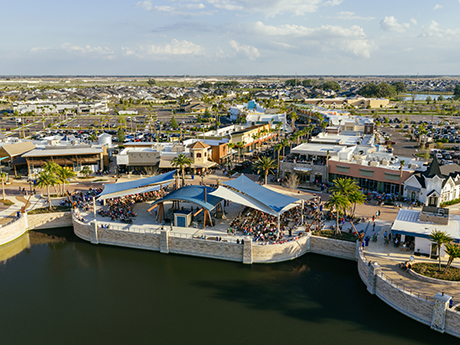
Florida’s The Villages has a secret: a captive, high-income population that dines and shops at the area’s more than 20 retail centers.
Many national tenants like to gatekeep great locations. For years, The Villages has been one of those. The master-planned, age-restricted community located in Central Florida is somewhat of an enigma to those who haven’t been. But visiting is eye-opening, and many national tenants have discovered a secret this utopia is hiding — an incredibly active and vibrant population with strong retail sales within the community’s 7.5 million square feet of retail. Shopping Center Business recently visited The Villages to find out more about the area’s retail offerings.
Growth Complex
The history of The Villages began in the late 1970s when Harold Schwartz purchased a parcel with a partner for a manufactured home park. In the early 1980s, Schwartz purchased his partner’s interest in the park, known as Orange Blossom Gardens, and brought his son, Gary Morse, in to run the property. Over time, Morse’s three children joined the business and the family acquired more land surrounding the park and expanded its offerings, eventually launching a homebuilding business in the early 1990s. Since that time, The Villages has steadily expanded, acquiring land parcels that it built into separate neighborhoods. The name was derived from the fact that separate neighborhoods make up the community — collectively, they are known as The Villages. Today, Gary Morse’s children, Mark, Jennifer and Tracy, all remain actively involved in leadership at The Villages and its related companies.
The Villages sits between Interstate 75 and the Florida Turnpike, about 30 miles north of downtown Orlando and about 45 miles northeast of the Tampa MSA. It is one of the fastest growing areas of Florida, and the nation.
“This area will continue to be one of the fastest growing areas of Florida over the next decade,” says Robert Chandler IV, CEO of The Villages. “The growth from Orlando and Tampa are both headed north, and we sit squarely in the crosshairs of both of those growth corridors.”
The Villages is delivering about eight homes every day of the year and closes about 20 sales per day when resales and new homes are combined. The company is delivering about 3,000 to 4,000 new homes per year. About 20 percent of new home sales in The Villages are to existing residents. Home prices are stable in The Villages, one of the major positives of living there. Because the area is under master community management, homeowners are held to high standards of property maintenance, which also aids property values. To maintain its tax status, 80 percent of homes in the Villages must have one member of the home over 55. The Villages does not allow those 18 and under to remain in a home for more than 30 days.
Age is just a number. And at The Villages, that saying proves itself true. The Villages’ restaurants teem with residents day and night; concerts on the community’s multiple town squares — held every evening — are packed with fun seeking residents; and its golf courses and recreation centers are used from dawn until evening. Being active is key to the culture at The Villages. Residents don’t seem to sit still — and there are no lulls in traffic at the community’s 17 shopping plazas and five lifestyle centers during from morning to night.
Designing A Lifestyle
Retail has always been an integral part of The Villages’ growth plan. As the number of villages grew, so did the community’s retail.
“We design and build everything in ratios, so as The Villages grows, each new area provides the additional amenities, trails, pathways and services that our residents desire; we don’t want to have sprawl that impacts infrastructure,” says Chandler.
As The Villages expanded, it developed a unique feature: the community’s golf car connectivity. The Villages is seamlessly connected through a series of golf car paths, in addition to traditional roadways. Over 40 years, that connectivity has steadily increased and it is one of the hallmarks of the community’s infrastructure. You will find golf car bridges over highways, tunnels under major intersections, and even stoplights when paths must cross busy roads. Parking lots have just as many golf cars — often parked three side-by-side to a space — as they do cars, trucks and SUVs.
“We build our golf car network first — every square inch of The Villages can be accessed by golf car,” says Chandler. “We build a lot of tunnels and bridges for golf cars. We are building that network for lifestyle and for the resident. It is ease of access. In The Villages, traditional methods of counting trips do not work, because so much of our traffic is via golf car.”
Today, The Villages spans 22 miles from north to south and includes almost 60,000 acres. The community is nearly 90 square miles — roughly four times the size of Manhattan — and sits in three counties. At about 85,000 homes presently, The Villages has enough land banked to keep growing for another 20 years — and it plans to do so.
“The Villages is all about lifestyle,” says Chandler. “And part of that lifestyle is making sure you have all the offerings that you want within a 15-minute drivetime — retail, restaurants, medical, recreation and golf.”
Home prices at The Villages range from $200,000 for a smaller villa to well over $1 million for waterside, well-appointed single-family homes. Regardless of a home’s value and size, every homeowner is assessed a $204 per month fee that grants permission to amenities like free recreation centers, pools, pickleball and tennis courts, and golf courses.
“We level the playing field for our residents, and that sets the culture at The Villages,” says Chandler. “Regardless of the type or cost of home you live in, access to The Villages lifestyle costs the same for everyone.”
Keeping Retail Close
Since the buildout of its first neighborhood, The Villages has kept retail as a focus as it developed. Realizing that residents would have to leave the community to buy groceries, the company developed its original shopping center in the mid-1990s. Today, there are five town center properties that are strategically located throughout the community, yet convenient enough they are accessible to all residents. There are also 15 neighborhood shopping centers within the property. The centers are anchored by nearly every national anchor imaginable, from Costco, Walmart, Hobby Lobby, Target, Havertys, to smaller tenants like Dunkin, Walgreens, McDonalds and 7-Eleven. More than a dozen grocery stores are part of the mix as well, including eight Publix-anchored centers and those anchored by Sprouts, Aldi and The Fresh Market. Seventeen professional plazas, with tenants like medical practices, dental offices and insurance agents, also fall within the purview of The Villages retail services.
The community currently has about 7.5 million square feet of commercial property — mostly retail and service centers — and the community sees annual retail sales of approximately $1.5 billion. The Villages has seen its population grow by more than 30 percent over the past five years, pushing its population to over 165,000. The Villages estimates that it will see about 14,000 new residents each year for the foreseeable future.
“We have strategically located our town center properties in centralized areas,” says Chandler. “With our grocery-anchored shopping centers, we have put these on the edges of our neighborhoods so that our residents can easily access them, but those from other neighborhoods can access them as well. We try to locate those on our main highways, but not at the intersections.
We like to locate our amenities at intersections since our residents access those almost every day.”
The Villages developed its first town center, Spanish Springs, in 1996. Similar to a lifestyle center in design, each town center has a performance stage in the center of the property. Every center has nightly programmed activities and entertainment. The town centers have restaurants flanked by lifestyle retail and service tenants. The Villages also operates some concessions, such as bars, adjacent to the stage area. The Villages developed its next town center, Lake Sumter Landing, in 2004, and followed with an additional town center, Brownwood, in 2014. Each center has a separate theme, designed to be in-line with nearby neighborhoods. Today, the company is finalizing development of Eastport, its latest town center, and working on the addition of Middleton. Middleton is the company’s first non-age restricted community, designed to support The Villages’ overall growth by attracting growing families and those working for businesses in and around The Villages, though anyone can live there. The Villages has strategically located a campus of its A-rated charter school in Middleton.
“We have at least 20 years of growth in front of us,” says Chandler. “We need to have a strong labor force to help us build and sustain The Villages. We know that in order to attract and retain great people, having quality schools, a variety of housing and a sense of community help us do that. We also want it to be a community that develops naturally, as any town should be.”
The town centers of Middleton and Eastport will create the vibrancy found at Spanish Springs, Lake Sumter Landing and Brownwood that support the thriving, active culture at The Villages. The town centers average about 405,000 square feet each and draw about 20 million people collectively.
A New Entrance
At the focus for The Villages retail team is the town center for Eastport. Developed over the past two years, the town center includes approximately 400,000 square feet of retail, restaurants and entertainment. Like The Villages’ other town centers, Eastport has an outdoor entertainment area at its center. It also has a large, 40-acre recreation center and the company’s new 90,000-square-foot home sales center, that serve as anchors, as well as a boutique hotel that opened in 2025.
Due to its proximity to the Florida Turnpike, Eastport will be the front door of The Villages for the next 20 years, says Chandler. With the development of Eastport and surrounding neighborhoods, the game is changing for The Villages. The community will have 12 miles of frontage on the Florida Turnpike, enhancing the community’s visibility to passersby, and making access easier.
“Eastport is in the unique position to serve our residents as well as the substantial regional growth,” says Chandler. “We put a little different leasing hat on for that reason.”
Another reason The Villages is seeking to put a different spin on Eastport is because the lifestyle at The Villages has evolved over the past decade. As younger Baby Boomers and Generation X have come of age, they have brought a more lively and active lifestyle with them. They pay much more attention to technology, pop culture and trends than older generations. These generations are also highly active — many residents still work, adopting a work hard/play hard mantra. For other residents, leisure time activities take up the bulk of their time. But make no mistake: those activities are active. Golf, walking, cycling, pickleball, paddling and even rock climbing are among the many popular activities that residents of The Villages undertake on a regular basis. And shopping, dining, meeting friends and groups of friends go right along with that — lunches, cocktail hours and dinner meetups are standing events multiple times per week with Villagers.
The community’s newer residents are also more affluent — prices for newly built homes are trending higher and more upscale, and residents’ tastes have led The Villages to continue to enhance the variety of restaurants and goods over time. Many long-time retailers and restaurants in The Villages know that the area’s residents expect quality paired with a great experience, and they will tell you that is the secret to success in the community. Because many are owner/operators and many managers are long-term employees, they create strong relationships with customers, which is appreciated and reciprocated with repeat business.
The average household income in The Villages is $165,000, a figure that surprises many prospective retailers. It is one of the reasons many national retailers are turning their attention to Eastport as an entry point into The Villages, says Chandler.
“Going after some of these nationally recognizable tenants is something that we haven’t really done at our town centers in the past, but that makes sense for Eastport,” says Chandler. “We have always had quality retail and restaurants at our centers, and we want to have a variety of offerings as well. Bringing in national tenants, mixed with local and regional retail, at Eastport is a way we can integrate some of what exists in other communities without sacrificing what differentiates The Villages.”
“One of the messages we have heard loud and clear from our residents is that they want a true, traditional regional lifestyle center with national tenants in the mix,” adds Phil Bernard, senior vice president of financial planning for The Villages. “In the past, we added a lot of services to our lifestyle center, such as dentists, financial planners and insurance brokers. At Eastport, we want to have food-and-beverage, entertainment and soft goods-oriented retail at the forefront.”
The Villages has brought on Mitch Friedel, executive director and head of retail development, advisory and leasing at Hilco Global and a nationally recognized expert in town center properties, to help introduce Eastport to national tenants. Friedel has worked on large-scale mixed-use and town center projects like Disney Springs in Orlando and Time Warner Center in New York City.
“We are working with a number of tenants you would recognize from the top town centers around the country,” says Friedel. “The lure of Eastport is prompting many of these tenants to open their first location in The Villages.”
Construction on Eastport is nearing completion, with some tenants already open or preparing to open. While much of Eastport’s retail is leased, the company did reserve some spaces for opportunity. It felt comfortable doing so because seeing the project in-person would be a stronger sell to a new type of tenant, says Friedel.
“The Morse family has created a great lifestyle at The Villages,” he says. “We are adding to the lifestyle that exists here. We are creating a lifestyle center with a concentration of prominent, nationally recognized retailers in one area that will set Eastport apart. It has all the facets you need to make a successful center, from an incredibly high-income base to a captive audience. In addition to that, The Villages has steady, predictive growth for the next 20 years.”
Eastport’s boutique hotel, golf course and 40-acre recreation center, draw residents and visitors daily. The sales center, which welcomes over 1,000 visitors per day, is also a big draw, since anyone interested in buying a new home will have to visit there.
“Between all of those pieces, we are very bullish on what Eastport can become,” says Chandler. “We have put together a great leasing plan and are making great strides toward filling it.”
“We play the long game on everything,” says Bernard. “We pride ourselves on pricing our homes so our residents don’t get upside-down. On the commercial side, while we are calculating returns, we are more focused on creating a town center that fits the lifestyle and serves our residents.”
In addition to Eastport, The Villages is underway with a multi-year redevelopment effort on Spanish Springs, its first town center. There, it is redeveloping the town square to make it more modern. It is adding rental apartments to the second-floor spaces, which were originally offices. It is also re-tenanting some spaces at the property.
“As some leases expire at our town centers, we are taking a big picture look at these centers,” says Bernard. “We are not just reinvesting to make properties look nice, but we want to make sure our retail properties have fresh and vibrant tenants that fit our residents’ needs and wants.”
Chandler also stresses that Eastport and Middleton are not where the story for retail expansion ends at The Villages. On the contrary, he says, The Villages is just getting started.
“Eastport is just setting the future,” he says. “This is the evolution of the town center product for us, but it is far from the last lifestyle center we will build. It just sets the tone for the next decade to come.”
— Randy Shearin
This article was originally published in the April 2026 issue of Shopping Center Business magazine.