

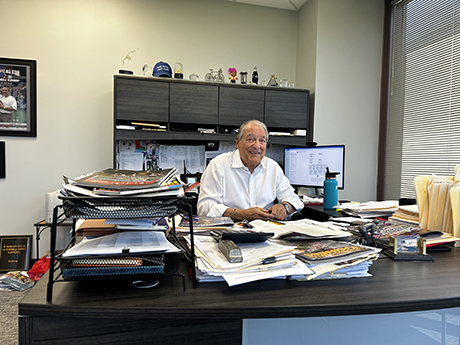
SCB Publisher Jerry France reflects on his 60-plus years in the industry, and the launch of Shopping Center Business, in conversation with the magazine’s editor.
Interview by Randall Shearin:
In celebration of Shopping Center Business’s 30th anniversary, I sat down with Jerry France, the publisher of the magazine and chairman and CEO of our parent company, France Media. Since Jerry has been my boss for the past 30 years, I have heard — and lived through — many of his stories and wanted to take the opportunity to get some of them on the record. In particular, I wanted to focus on the launch of Shopping Center Business and some of the more memorable moments of the past 30 years.
Shopping Center Business and France Media have been just part of a long and successful career for Jerry France. A person who does not let his age define him, he works every day, still keeps up with many friends in the shopping center industry and is a driving force in the realm of entertainment and retail.
Shearin: You launched Shopping Center Business 30 years ago but your history in the real estate publishing business goes back 60 years. Can you tell us what you did before launching the magazine — and how you got involved in commercial real estate publishing?
France: When I finished college in the early 1960s, I went to work for an advertising publishers’ rep firm in Chicago that represented both trade and consumer magazines. Those titles included Modern Photography, High Fidelity, Show Magazine, Computer World, Playbill and Ad Week. During that time, I started to sell advertising in a new magazine that covered commercial real estate called National Real Estate Investor. What I enjoyed most about this magazine was that it covered all aspects of commercial real estate. After a few years, I became a partner with the firm and then was offered an opportunity by the publisher of National Real Estate Investor to move over to his company and represent the magazines they were publishing in the Midwest and Southwest — two very vibrant areas of the country for commercial real estate at the time. This was during the time when commercial real estate development was really starting to boom — office, industrial and particularly retail. Over time, I became senior vice president of sales and marketing for that company, and in 1987, I moved to Atlanta to become president of the company. At that time, we had 40 magazines covering topics from avionics to waste. If you sat next to me on an airplane, I could talk to you about a lot of things.
Shearin: What events led to the start of Shopping Center Business?
France: While I was with that company, I had the opportunity to be involved with the launch of a magazine called Shopping Center World, which I ended up running and building to become the primary magazine for the shopping center industry. That is where I really got into the retail sector and realized how much I absolutely loved it. This was during the early years when the shopping center industry was just starting to explode — malls were being built and many different retailers were being launched.
In late 1995, that company was bought by an investment company. By early 1996, it was time for me to leave. I like to say that I left on a Friday, retired for the weekend, and then launched Shopping Center Business the following Monday with my son, Scott, and we have never looked back.
Shearin: Why did you think it was time to start Shopping Center Business? And what did you do differently?
France: The retail sector of commercial real estate is something that I have always really enjoyed based on the people, the excitement and the creativity. I really wanted to create a magazine that was more on the idea of a Forbes magazine. I wanted to be more creative, and I wanted to delve more into the retail sector, which I was able to do when I hired you, after two meetings at Starbucks. We were able to put together a magazine that was talking about where the industry was going and not where it was. We really wanted to show the business of owning assets, not operating assets. The shopping center industry was going from a business where you operated as assets to a business where you operated portfolios of assets. We needed to cover the business as an institutional investor would see it, not through the lens of property operations. We weren’t going to cover flooring, carousels and gumball machines. We really wanted to profile developers, owners, financiers and retailers. And that is what we have continued to do throughout the 30 years of publishing Shopping Center Business.
Shearin: Were you surprised by the amount of support you received from the industry when you launched the publication?
France: The response that I received from the industry really surprised me. I can remember sitting with my family after spending 33 years with a company and launching my own saying, ‘I must have done something right over the first 33 years of my career to get the response that I’ve received.’ I had CEOs of companies all over the industry calling me saying, ‘Jerry, do you need any help?’ Some wanted to invest with me, but I really wanted to do it on my own. I even had Eddie DeBartolo — who I will never forget — call me up and say, ‘Jerry, do you need any help?’ And I said, ‘no.’ And the next thing he said to me was, ‘put me down for 12 pages.’ We published the first issue of Shopping Center Business — which we launched in seven weeks — with 110 pages of advertising, which is probably a record. And from that point forward, the magazine was in the black and we were on our way.
Shearin: It was a feat to put together.
France: It was. Our first cover story was on GameWorks, which was just about to open its first unit at the time. We had David Geffen, Jeffrey Katzenberg, Edgar Bronfman, Steven Spielberg and the CEO of Sega Enterprises on the cover. I remember seeing that USA Today only had a paragraph about GameWorks, but we had a cover story because of connections we had in the shopping center industry.
Shearin: We’ve traveled and interviewed a lot of people in this business — sometimes celebrities who were dipping their toes into the retail world. What are some of the more memorable interviews that you’ve had over the years?
France: You and I traveled a lot together and it seemed like we were attached at the hip sometimes. I wanted us to be very hands on with the magazine. Traveling and conducting interviews together shows people in the industry how involved we are and how much we care about the industry — and our desire to run the best stories with information from the source. The first trip we took, we went to New York, and in two days we had 16 appointments from Wall Street to Greenwich. We have interviewed a lot of noteworthy people over the years. We met with Howard Schultz of Starbucks Coffee; Dick Clark of American Bandstand; Art Linkletter; Magic Johnson when he opened his theaters. They were all very gracious. We also met with Mayor Daley of Chicago and Mayor Williams of Washington, D.C. We interviewed many of the greats of the shopping center industry, including Eddie DeBartolo, Alfred Taubman and many of the Simon family. We also interviewed multiple generations of some of the industry’s development families, like the Taubman, Cafaro, Zamias and Pasquerilla families. We’ve been in the offices of so many retailers — Crate & Barrel, The Cheesecake Factory, Gap, Disney Stores, McDonalds, Zale, Dick’s Sporting Goods are just a few I can think of.
Shearin: Do you have a favorite cover of Shopping Center Business?
France: A memorable cover was from our Howard Schultz interview where we used the Starbucks logo (May 2000). It attracted a lot of people to our magazine. It also led a lot of people to our booth at ICSC Las Vegas asking, ‘where’s the coffee?’ In general, my favorite covers were when my daughter was the graphic designer because it was nice to see her talent shine.
Shearin: What has been the most rewarding aspect of being the publisher of Shopping Center Business for the past 30 years?
France: The friends that I have made in the shopping center industry and the relationships that I have been able to cultivate over the years. It has been a lot of fun to meet some of the biggest creators in the industry, like Mel Simon and his brother Herb, and watch their companies grow. They were just delightful guys and fun to be with. I used to publish a picture in the magazine with the person interviewed for the cover, and people used to follow me around the country based on those pictures. I had a few CEOs say, ‘Jerry, I don’t think I’ve made it yet until I get a picture in the magazine with you.’ One of the other rewarding aspects has been to watch our employees grow.
First, I have to credit my son, Scott, who took a chance and grew with me. He had been in sales at my former company as an associate publisher. He is now president of France Media, co-publisher of Shopping Center Business, and publisher of a number of our magazines. People in the industry know him well and he has great relationships with many of our clients. He does a tremendous job and it has been nice to watch him continue to build upon what we started 30 years ago. You have also grown, going from editor to editorial director to heading up our operations companywide. We also have many people, like Ryan Nixon, Jaime Lackey, Rich Kelley, Matt Valley, Barbara Sherer, Julie Hunt, and Teresa Hennington who have been with us for over 15 years and many that have been with us for more than 10 years. It has been great to watch them grow and succeed.
Shearin: In 2015, SCB launched the Entertainment Experience Evolution conference, which has showcased the future of the retail industry for more than 10 years now. We’ve always been fans of entertainment and dining as tenants. How have you seen that change over the years?
France: The shopping center industry has changed dramatically over the past five to 10 years. When we started the magazine, the shopping center industry was exploding with new development. It’s strange to think back to when I was a little kid going to shopping centers and how that was really the embryo of an industry that was going to be the main growth vehicle for retail in our country. In the 1980s and ’90s, the malls were king — that was what was being built and developed. Since I started in the business, the industry has taken a 180-degree turn where the malls are not necessarily ruling the roost. Now, it’s more mixed-use development and entertainment concepts that are tied into sports venues. Some of the biggest development projects today are the redevelopments of former enclosed malls! In 2015, a lot of malls were closing and there was a lot of vacant space. You could see that the industry was having a difficult time with how to move forward. That’s when we came up with the idea for Entertainment Experience Evolution. We could see that the retail sector was going beyond theaters for entertainment and becoming more restaurants, gaming and other types of concepts on the entertainment side — and there was plenty of room for those tenants. Because of that, we thought that the conference would be a great way to continue building our involvement in the shopping center industry.
Shearin: We have seen a lot of change in the industry since we launched in 1996. The industry had moved from entrepreneurial to institutional. Today, small companies are really at the core of the development business again. Small retailers are also the ones getting the most attention. In some ways, it is full circle to a much smaller industry with an entrepreneurial spirit. What are your thoughts on where the industry is headed?
France: Since COVID, a lot of retail space hasn’t been built, so it is really a landlord’s market and a seller’s market. There’s not a whole lot of supply, but there’s a lot of demand because retailers must continue to grow. There have been a lot of retailers that have closed, but a lot of new ones that want to expand. The mainstream media talks about shopping centers dying, but they really aren’t. There have been so many new retailers created — many of whom started by being internet-based. Now, department stores are shrinking locations because they are underperforming, but that doesn’t mean they’re going away. They’re trying to become more profitable by eliminating the problem stores. Technology is really aiding with that effort, similar to how it did with mall development. Retailers look at cell phone traffic now to follow consumers. Years ago, the development arm of Sears, Homart, determined where malls should be built based on the ZIP codes of people shopping in Sears’ stores and catalogs.
Shearin: You’re in touch with different generations — you have children and grandchildren. What do you think the future of physical retail is?
France: I think that Gen Z is starting to see that shopping malls are great places to go because they can socialize and enjoy the fruits of all the retailers in a single place — a shopping center. But one of the things that is changing is that a shopping center is not just retail anymore. You’re getting dentists, healthcare, entertainment — a mix of tenants that are not necessarily all retailers. And restaurants, of course, which are a great generator of traffic. Every developer out there is looking at what they can put in their center that will create traffic. Developers have come to understand is that a center must have a sense of place. That could be as simple as convenient parking and as complex as regular programmed entertainment and events. If you create a place where you can bring your family and they can sit around green spaces while the kids play, then you have created something that is going to continue to grow and create traffic. People will come back because of the green space, restaurants and, of course, the retail.
Shearin: What excites you about this business and keeps you coming to work every day?
France: I love this industry. Even going to ICSC Las Vegas — I still call it the shopping center convention — when I walk around, I see a lot of new companies. I also see a lot of companies that I know, but the people that I knew are no longer there. That makes me sad, even though I love to meet new people. There were a lot of great people in the industry who have retired or, unfortunately, are no longer with us. There is a new generation in charge and that is nice to see, but I do miss seeing some of the old guard. Part of the maturation of this industry is that it is much more sophisticated than when I started — or even when you started. It’s been said to me many times by the generation older than me that the shopping center industry used to work on a handshake. You had a handshake, you made a deal. And that is something that has disappeared. I think perhaps a lot of it has to do with the fact that the shopping center industry has become very institutionalized. One thing I have learned about the industry since launching the entertainment conference is how creative it is. There is always some new concept or some new shopping center type. And a good percentage of the new retail and entertainment concepts coming into shopping centers today are not coming from the United States. They’re coming from overseas. Some of the prettiest and most creative shopping centers are being built in other parts of the world, like the Middle East, India and Asia.
This article was originally published in the May 2026 issue of Shopping Center Business magazine.