

Residents are flocking to the Carolinas, and retailers and developers are overcoming obstacles to address the growing demand.
North Carolina and South Carolina are throwing their hats into the ring as two of the fastest growing states in the nation. At 1.5 percent, South Carolina had the highest population growth rate in 2025, according to the U.S. Census Bureau. Similarly, North Carolina attracted 84,000 residents from other states last year, making the Tarheel State the No. 1 state for domestic migration.
North Carolina was also the third-fastest growing state in terms of total population growth behind only Texas and Florida. Additionally, both states ranked in the top five of the 2025 U-Haul Growth Index, which tracks one-way moving patterns across U-Haul’s fleet of moving vehicles.
“Retail follows the rooftops, and the rooftops are growing in the Carolinas, both in number and in quality in terms of household income that retailers and restaurant groups are targeting,” says Scott Burgess, vice president of Colliers’ Greenville office. “With the growth in the Southeast in general and in the Carolinas, there’s a huge demand for retail space.”
James McAden, development partner at RealtyLink, says that developing retail in the Carolinas has long been the “heart and soul of our company.” The Greenville-based developer has recently delivered a string of single- and multi-tenant retail properties in the Carolinas leased to tenants including Bojangles, City BBQ, Dave’s Hot Chicken, Dunkin’ and Verizon Wireless.
“We have a continued focus on retail in the Carolinas, it’s a fun vertical to be in,” says McAden. “We’ve seen so much demographic growth in the Southeast, and there’s always new brands entering the fray in retail. There’s always going to be a demand for good retail real estate [in the Carolinas].”
“We are spending a good amount of time in the Carolinas for all the obvious reasons,” adds Brian Dawson, CEO of GBT Realty, a commercial real estate development firm based in Brentwood, Tennessee. “It’s a destination, it offers a wonderful quality of life compared to other parts of the country and there’s still affordability. We really believe in the Carolinas, which is aligned with where our capital wants to be placed.”
In addition to leading the nation in certain population growth metrics, the Carolinas have retail markets that are outperforming the national average in several categories, namely occupancy. Charlotte, Raleigh-Durham, Charleston and South Carolina’s Upstate region (Greenville-Spartanburg) all have vacancy rates well below the national average.
In its “2026 Retail Investment Forecast,” Marcus & Millichap ranked three Carolinas markets among the top four U.S. retail markets for the new year: Charlotte was ranked No. 1, Raleigh came in at No. 2 and Charleston was No. 4. (Greenville wasn’t among the 50 markets tracked by Marcus & Millichap, which used forward-looking economic indicators such as projected job growth and household formation when generating its rankings, as well as retail real estate metrics such as vacancy, construction, retail sales and rental rates.)
A cocktail of strong population growth and tight occupancy in the Carolinas should theoretically equate to a wave of new retail construction. However, construction is somewhat stymied due to labor, land, insurance, borrowing costs and construction materials pricing remaining elevated.
“New construction is not holding pace with the population growth,” says Charlie Coyne, executive vice president and retail team lead in CBRE’s Raleigh office. “A lot of that is dictated by continued challenges in the debt markets and price of site work and vertical construction.”
“There is a big delta between the rents that you can get in existing product versus new product, so it’s hard to justify building in a lot of cases because only a certain group of tenants can pay it,” adds Burgess. “Occupancy is really high in [the Upstate] market, so we get giddy when we get an availability in our listings because we know they’re going to go quickly.”
If ground-up construction is challenging, perhaps the adaptive reuse route would make sense as a seemingly economical way to deliver infill retail space. In years past developers would take obsolete factories and mills in infill submarkets and convert those to unique shops and restaurants. While there are some projects in the works that fit this model (more on that later), these markets also double as strong industrial markets as they have favorable locations along the I-85 corridor (Raleigh, Charlotte and Greenville) or are situated near one of the strongest ports on the East Coast (Charleston).
“There is not as much adaptive reuse in Charleston for retail space because the market has such strong demand for these smaller flex and industrial projects,” says Will Sherrod, associate at NAI Charleston. “Converting them might not be as cost effective as it should be because landlords can keep being profitable with older flex space, and they don’t typically have the parking needs that retail requires.”
Nonstop in North Carolina
The tightness in each of the Carolinas’ top retail markets is undeniable. According to Colliers research, Charlotte has a nearly 2.8 percent vacancy rate as of year-end 2025. This marks three full calendar years where the vacancy rate has been below 3 percent. There is roughly 670,000 square feet of retail space under construction currently, which represents a sliver of the metro Charlotte overall retail inventory (more than 133 million square feet).
Just like Marcus & Millichap’s forecast report, CoStar Group named Charlotte as the No. 1 retail market in its annual ranking for 2025, which noted that Charlotte had the highest asking rent growth (7.4 percent) and total return for retail space (11.6 percent).
“Charlotte has evolved since COVID,” says Rhett Batanides, senior vice president, national retail expansion at Foundry Commercial. “But Charlotte is in its teenage years. The market is still growing up, and the retail is catching up to the growth.”
While new construction isn’t as robust as one might think for the No. 1 retail market in the country for both 2025 and 2026, there are various projects that are creating buzz both locally and nationally.
Just north of the city’s Uptown district, Camp North End is getting an infusion of capital and expert retail placemaking. Atlanta-based Jamestown has partnered with existing ownership to recapitalize the 76-acre mixed-use redevelopment project, which was originally constructed in 1924 as a Ford Model T plant.
Today, Camp North End features a mix of office, residential, retail, restaurant and public gathering space, with an additional 3.2 million square feet of land entitlements secured for future development. Approximately 500,000 square feet of mixed-use space has been delivered at Camp North End, which is home to various office tenants such as Google Fiber, Ally Bank’s TM Studio and Centene’s Caolina Complete Health, as well as several retail tenants including Tipsy Pickle, Hex Coffee and Surefire Market.
ATCO Properties & Management will remain a partner in the overall development, while Shorenstein Investment Advisors will continue as a partner with Jamestown and ATCO in a portion of the project. Jamestown has retained PointBlank Ventures to raise joint venture equity for the next phases of development.
On Charlotte’s east side, the former Eastland Mall is getting an overhaul from a public-private partnership between Crosland Southeast, the City of Charlotte and Mecklenburg County. The $117 million redevelopment is known as Eastland Yards. In early March the City of Charlotte broke ground on Eastland Sports Campus, a 29-acre, $67.1 million amateur sports campus within Eastland Yards.
“It’s an 80-acre mixed-use redevelopment that will have residential, retail and a 100,000-square-foot complex for sports and live music,” says Batanides. “It’ll be a staple of that community for years to come. That combination of multifamily and retail has been missing in that corridor of east Charlotte for a very long time. There’s a need for a solid retail project on that part of town.”
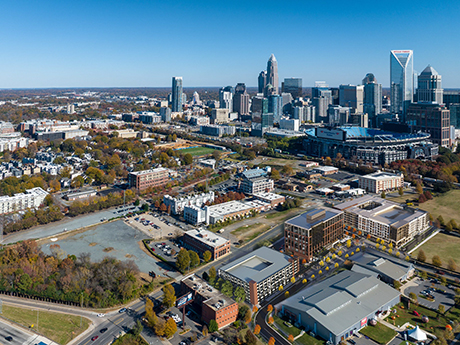
Eastland Yards will be serviced by the extension of the east-west Gold Line streetcar of the Charlotte Area Transit System (CATS). The transit authority will also add a station for the Gold Line within the upcoming Iron District, a mixed-use development project that will sit adjacent to Bank of America Stadium, home of the NFL’s Carolina Panthers and MLS’ Charlotte FC. The stadium itself is getting an $800 million overhaul that will include stadium renovations and a 4,400-seat live music venue next to the newly renovated practice facility.
Trammell Crow Co. recently broke ground on the first phase of Iron District, which will include 160,000 square feet of ground-level retail space. The Dallas-based owner has also brought on Tommy Mann, who was instrumental in the retail component of Camp North End, to oversee the merchandising strategy. Foundry Commercial is handling the development’s retail leasing assignment.
“Iron District is going to be a generational project for the city,” says Batanides. “Its location is incredibly strategic — right beside where the Panthers and Charlotte FC play, and where so many concerts and major events are held. With that kind of activity surrounding it, this is poised to be the top retail project in the area for years to come.”
Batanides adds that his firm is targeting best-in-class retailers, food-and-beverage users and entertainment operators at Iron District, with an added goal of delivering Charlotte’s first apparel district.
“Most cities have an apparel district, but Charlotte doesn’t right now,” he says. Foundry is also handling the retail leasing at AvidXchange Music Factory, a nearby 30-acre entertainment and live music campus in Uptown Charlotte. The firm will advise and market the property’s 60,000 square feet of space.
Up I-85 from Charlotte, the Raleigh-Durham retail market has an even lower vacancy rate than Charlotte. At 2.4 percent, the Triangle region has one of the tighter retail markets in the country, according to Colliers research. For buildings 10,000 square feet or smaller, the market is even more competitive as the vacancy rate stands at 1.6 percent.
“Raleigh has the lowest retail vacancy in the country, depending on which research outlet you read,” says Coyne of CBRE. “We’re seeing lower vacancy in the suburbs, as well as more development activity.”
Coyne says that market-wide, CBRE is tracking 35 new developments in the pipeline that will add 3.5 million square feet of space to the local supply between now and 2030.
“We are starting to see new development projects pencil, get approved and get equity and debt,” says Coyne.
Some of the suburban developments in the region include Gold Leaf Crossing in Fuquay-Varina and a $100 million development in Clayton by Casto that just received rezoning approval last month. Recently delivered suburban projects include Sweetwater Town Center in Apex, Wallbrook in Rolesville and Fenton in Cary.
Within the urban core, Northwood Retail is redeveloping Northgate Mall in Durham. The firm is selling a portion of the project, which was renamed Ellerbe Square, to Regency Centers and has tapped CBRE to lease the first phase of the project.
“Phase I is Northwood renovating the mall’s retail space with renovations to shops and a new specialty grocer and outparcels,” says Coyne. “Regency is developing a Target with shops and outparcels in Phase II.”
Dawson adds that GBT Realty doesn’t have anything to announce in the Triangle yet, but the company is currently monitoring opportunities.
“We believe in the Research Triangle market like most other investors do, it’s no longer a tertiary market,” says Dawson. “We just put in a bid to acquire a retail center in the market.”
South Carolina Shines
Like its peer markets in North Carolina, Charleston’s retail market also has a sub-3 percent vacancy rate (2.9 percent), according to the latest Colliers research. The market is also seeing minimal new construction, with only 52,700 square feet of retail space under construction, which represents less than 0.3 percent of the market’s existing inventory (20.9 million square feet).
“The market is really tight right now, and space is competitive,” says Justin Ross, vice president of Colliers’ Charleston office. “Tenants need to be ready to move quickly on space, because good space is not sitting for long. We have tenants coming from all over the country and all over the world really that want to be in Charleston.”
“Charleston is great if you’re an owner with well-located space, but if you’re a tenant looking for that space, it’s not so great,” adds Sherrod of NAI Charleston. “Tenants are running into extremely high rental rates and fewer landlord concessions than they hoped for.”
Downtown Charleston famously has topographical and historical barriers to entry for new retail development, but that doesn’t mean it’s impossible to add meaningful retail space. Fourthline Capital Management purchased 200 Meeting Street in downtown Charleston’s French Quarter district last year. The firm has hired Colliers to lease the property’s fully redeveloped offices and 30,000 square feet of ground-level retail space.
“200 Meeting Street has been hiding in plain sight,” says Ross, who says that 200 Meeting Street’s connected parking deck is a differentiator for the market. “It’s going to be a first-class project.”
For the most part, the movement in metro Charleston’s retail market is outward to its suburbs. However, even with strong demand, some of the jurisdictions throughout the Charleston MSA are taking a cautious approach to adding retail density.
“For a market growing as rapidly as metro Charleston is, the municipalities are having a hard time keeping up and/or they’re doing what they can do to slow growth,” says Sherrod. “West Ashley and Summerville, including Carnes Crossroads, Nexton and the Cane Bay master-planned developments, are the only logical places where growth can go because of the available land.”
Sherrod says that the Cane Bay master-planned community will soon get a Walmart Supercenter and a Lowes Foods grocery store.
NAI Charleston is also leasing The Marketplace at Carnes Crosssroads, a Publix-anchored shopping center that will also include a SpringHill Suites hotel and several outparcels housing Chase Bank, McDonald’s and Zaxby’s.
“That project has always been in the path of growth,” says Sherrod. “It was a very fun project to work on, it’s been rewarding seeing how much success it has.”
Near that project, GBT Realty recently delivered Village at Carnes Crossroads, an apartment community in Summerville, South Carolina, that features some retail space on the ground level. Committed tenants include Galaxy Nail, GoodVets, MyEyeDr and Tous les Jours.
In Ridgeville, Santee Cooper, South Carolina’s state-owned electric and water utility, is spearheading Camp Hall, a 1,300-acre commerce park.
Colliers is handling the leasing of a 120-acre commercial swath at Camp Hall that will be named Avian Commons.
“Avian Commons is a next-generation park with walking trails, and there’s already pickleball and tennis courts,” says Ross. “Colliers did a deal with Refuel, which has opened a gas station/convenience store at Avian Commons. We’re also under contract with a childcare concept, and we are going to start selling pads for more retail development.”
Heading west in the Palmetto State, the Greenville-Spartanburg retail market has a vacancy rate a shade below 4 percent, which is roughly 30 basis points below the national average (4.3 percent), according to the latest Colliers research.
“I would say the Upstate retail market is healthy,” says Macy Scoggins, senior brokerage associate at Colliers’ Greenville office. “We have a very low vacancy rate and plenty of tenants and new concepts are looking to be in the market.”
Like Charlotte and Raleigh, the Greenville-Spartanburg market is enjoying solid population growth and employment opportunities due to the presence of employers including BMW, GE, Michelin and Prisma Health, among others. Burgess of Colliers says that the growth has been pretty widespread across the MSA.
“Residential growth is pushing everywhere,” says Burgess. “There’s Anderson to the south and Traveler’s Rest to the north, which is more lifestyle-based. There’s a good story for growth in every direction. We’re lucky to be where we are, and we try to just not get in the way.”
Jake Scott, an associate at NAI Earle Furman, concurs that the Upstate’s growth isn’t tied to one submarket or county.
“Everything is kind of growing into itself; markets like Piedmont and Pendleton are rapidly expanding from a housing perspective,” says Scott. “On the north side there are markets like Duncan and Boiling Springs that are growing, even in Woodruff. Developers are putting housing down anywhere they can right now.”
“Growth is occurring one exit at a time,” adds Geoff Beans, senior associate at NAI Earle Furman.
Scoggins says that the main challenge in the Upstate region currently is the lack of quality available space as well as a dearth of new development. According to Colliers, approximately 53,000 square feet of retail space is under construction, which represents less than 0.2 percent of the market’s existing inventory (29.2 million square feet).
“There are some new developments in the works, but they’re months and months out,” says Scoggins. “Tenants are having a hard time finding suitable space right now.”
NAI Earle Furman is handling the leasing for Pinestone, a new mixed-use village underway in downtown Traveler’s Rest. Scott says that the residential component, which features traditional apartments, townhomes and single-family homes, is fully built out and features direct access to Main Street and the popular Swamp Rabbit Trail. The development team includes locally based TRG Communities and Longbranch Development.
“We are about to deliver a warehouse component on the commercial side of Pinestone that will have a food hall and entertainment area,” says Scott. “We’re currently looking for tenants to fill those spaces that will serve the community of Traveler’s Rest, including restaurants, breweries and coffee shops.”
Scott adds that on the other side of U.S. Route 25, Pinestone will feature three mixed-use buildings with offices sitting atop ground-level retail space.
“We have signed deals with a couple restaurants,” says Scott. “The commercial component on the other side has a bit longer timeline to get some critical mass.”
Tenants on the move
Within some of the aforementioned developments, some of the biggest retailers in the country are staking their claims. Target recently opened its 2,000th store at Gold Leaf Crossing in Fuquay-Varina, North Carolina. The Minneapolis-based retailer plans to open additional stores in Mebane, Myrtle Grove and Selma, North Carolina in the coming months. Target will also open stores in Seneca, Rock Hill and Lexington, South Carolina, as the retailer plans to open 300 new stores by 2035.
One of the more high-profile tenant announcements in the past few years for the Carolinas came when Wegmans announced it was going to open a large-format grocery store in Charlotte’s Ballantyne district. The new store, which will anchor The Bowl at Ballantyne within Northwood Investors’ 2,000-acre master-planned Ballantyne community, represents the southernmost Wegmans in the Rochester, New York-based company’s portfolio. The new Wegmans is slated to open in the fall and generate 450 new jobs.
The Carolinas continue to attract activity from a variety of grocers, including homegrown Food Lion. The Salisbury, North Carolina-based grocer recently announced it was investing $484 million to remodel 153 stores in the metro Charlotte region. Additionally, Food Lion recently opened stores in Greensboro and Statesville, North Carolina, as well as Pontiac and Simpsonville, South Carolina.
Lowes Foods, another regional grocer, recently converted former KJ’s Market locations in Johns Island and Lyman, South Carolina into Lowes Foods grocery stores. The Winson-Salem-based grocer also opened new ground-up locations in the Research Triangle region: Wendell and Fuquay-Varina.
Publix also continues its expansion in the Carolinas’ top markets. The Lakeland, Florida-based grocer has recently opened stores in Charlotte, Garner and Raleigh, North Carolina. New Publix stores in South Carolina include locations in Aiken, Daniel Island, Mauldin and Summerville.
“We’re seeing more grocers,” says Scott of NAI Earle Furman. “We expect that to continue as these housing pockets continue to pop up.”
Sprouts Farmers Market is another grocer targeting the Carolinas in its expansion process. The Phoenix-based grocer recently opened a store in Charlotte’s NoDa neighborhood.
“This year, GBT Realty will be closing on five opportunities in North and South Carolina, rolling out Sprouts Farmers Market-anchored shopping centers,” says Dawson.
Buc-ee’s also recently announced its first location in North Carolina. In 2027, the company will open a massive travel center and convenience store in Mebane. Within a typical Buc-ee’s patrons can find walls of Buc-ee’s merchandise, including apparel, home goods and souvenirs, as well as a wealth of food options including candy, chips, soft drinks, a coffee bar, kitchen with to-go food and its signature beef jerky wall.
Among the most rapidly expanding retail concepts, many tend to fall into the single-tenant, net lease (STNL) category. Part of that is due to the land opportunities available for these retail concepts, many of which require a drive-thru. RealtyLink’s McAden also notes that it makes sense for developers to build STNLs or smaller unanchored retail centers from a risk perspective.
“Bigger projects come with more risk, it’s just more dollars on the line,” says McAden. “The buyer pool for a STNL deal such as Wendy’s or Bojangles is a lot bigger than for a large shopping center, plus it’s often easier to raise capital for smaller deals than larger ones.”
McAden says that RealtyLink has been actively developing STNLs in the Carolinas for various concepts.
“We turned over four or five Bojangles last year, and we broke ground in late January on South Carolina’s first Shake Shack — we’re very proud of that deal,” says McAden. “We just signed a lease with Dutch Bros, which is another brand that is entering South Carolina. It’ll be its third or fourth in the state.”
Scoggins of Colliers confirms that drive-thru coffee and beverage concepts are expanding in the Upstate region, though not at a clip that one might expect.
“Users like 7 Brew, Swig, Dutch Bros, Caribou Coffee and Scooter’s — they’re all looking hard, but it’s becoming harder and harder to find quality drive-thru sites,” says Scoggins.
Her colleague Burgess also points out that growth-minded quick-service restaurant (QSR) concepts are also busy expanding in the Upstate.
“We did Raising Cane’s first deal in the Upstate,” says Burgess, speaking about the Texas-based fried chicken finger QSR. “It speaks to a lot of the action underway. We are getting high-credit concepts like Raising Cane’s, Whataburger and Cava. These groups are really excited about South Carolina.”
“Brands like Whataburger are picking our market as a way to expand in the Carolinas,” adds Beans of NAI Earle Furman. “Greenville-Spartanburg is sitting on a pedestal right now as the next real opportunity for these companies.”
— John Nelson
This article was originally published in the March 2026 issue of Shopping Center Business magazine.