

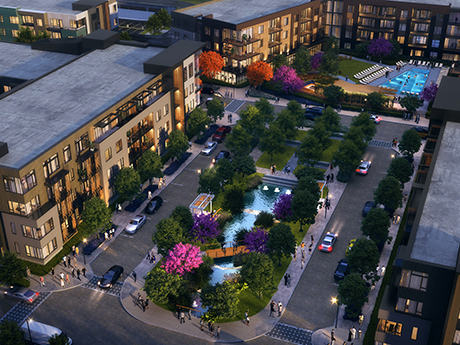
With development costs high, developers are turning to mixed-use projects to maximize land while offering consumers a more rounded experience.
As 7 a.m. rolls around, the elevator doors open to the smell of fresh espresso drifting up from the downstairs café. By noon, the outside plaza is alive with office workers grabbing lunch, parents pushing strollers and residents walking their dogs past storefront windows. In the evening, string lights flicker above the courtyard as neighbors gather for dinner just steps from their home. This is not a weekend destination or a drive-to shopping center, it’s what is frequently defined as daily life inside of a mixed-use development.
This vision sits in contrast to traditional retail strip centers, where parking lots are predominant and storefront activity pulses heavily on the weekends. At a traditional center, you arrive, you purchase and you leave. The space serves a single purpose, for certain hours — and developers are paying attention to this difference.
As the construction of mixed-use developments has surged over the past two decades, traditional retail is supporting its growth — not hindering it.
Where retail centers were once built to capture movement, mixed-use developments are designed to create it. By layering residential, office, hospitality and curated retail into one integrated environment, these projects are generating built-in routines and foot traffic, with sustained activity throughout the day. More importantly, they’re fostering a sense of place — a characteristic that is becoming increasingly valued by both tenants and communities.
Where Convenience Meets Experience
Belle Oaks Marketplace, a 1.7 million-square-foot transformative mixed-use redevelopment, is redefining the suburban landscape in the greater Cleveland market. Situated on the 69-acre footprint of the former Richmond Town Square Mall in Richmond Heights, Ohio, the three-phase project is designed as a live-work-play community that blends nearly 800 luxury residential units with approximately 354,230 square feet of retail, dining and daily-needs amenities.
Described as a “jewel box on the hill” because of its retail-inspired night lighting, Belle Oaks Marketplace will showcase a myriad of unique elements upon completion, including the Sterling Club, a nearly 9,000-square-foot private club that offers wellness, fitness and social spaces for residents; a 10-acre park with a turtle pond; a 20,000-square-foot community event center; a 12,000-square-foot resort clubhouse; a year-round swimming pool; and keyless entry into the community.
“Cleveland, as a city, has really embraced and moved forward to help put this project together,” says Sterling McGregor, president of Los Angeles-based DealPoint Merrill, who is developing the project. “People want to immerse themselves in a public space that’s vibrant, inclusive, community-driven, and where there’s a local identity.”
Anchored by a newly opened, 160,000-square-foot Meijer grocery store — which is the first major retail location to open within the $300 million project — Belle Oaks Marketplace will also feature a Firestone Complete Auto Care, Walgreens Pharmacy, Dollar Bank, drop-off dry cleaning services, a car wash, urgent care and a climate-controlled storage facility, furthering emphasizing McGregor’s “village community” concept.
“People don’t want to drive anymore — they want all of these things near them — and that’s why they’re moving ‘downtown,’” says McGregor.
Many developers are particularly embracing mixed-use concepts that cluster everyday amenities within a single, walkable vicinity. By prioritizing convenience and quality of life by reducing the need for travel, they are minimizing the need for constant errands and giving residents something that is increasingly valuable — time.
“Belle Oaks is designed to leave you with more time for you,” he says. “We’re creating a community, which is something people actually want.”
Creating Synergy
Belle Oaks Marketplace highlights how mixed-use developments are reshaping communities by blending residential, retail and public space into one cohesive environment, but this shift isn’t confined to one region. A strong example of this momentum can be seen in Atlanta with The Works, where industrial development has been converted into a vibrant hub for dining, office space, apartments and entertainment space.
Steven Baile, chief development and operating officer at Selig Enterprises, explains that not only does mixed-use diversify the company’s portfolio, but the various aspects of mixed-use developments have created productive synergies that support the overall retail product.
“The retail greatly benefits from a population that’s office oriented. You’ve got daytime workers that are there, so you’re not just reliant on the neighborhood itself,” Baile says.
Located in Atlanta’s Upper Westside neighborhood, The Works began as a collection of warehouse and manufacturing buildings that opened in 2021 as a planned 80-acre adaptive reuse project. The first 27-acre phase features 500,000 square feet of fully leased office space; Westbound at The Works, a 306-unit apartment complex; 350,000 square feet of retail, restaurant and entertainment space including Chattahoochee Food Works, a 31-stall food hall; and outdoor gathering spaces such as Fetch Park, an off-leash dog park, and The Camp, an outdoor playground and live music space.
While the initial phase is largely complete, Selig Enterprises has submitted a rezoning request for the second phase of The Works, proposing an additional mix of multifamily, office and retail components, which will stretch the remaining 53 acres of the site. As reported by The Atlanta Journal-Constitution, the project could span approximately 2.2 million square feet of new development over the next five years.
Because broader market forces are shaping the way people live, work and shop, the shift in development starts from traditional retail centers to mixed-use centers has been steady. The rise of e-commerce has also reduced demand for large footprints of pure retail space, and instead, introduced the concept of more walkable, experience-driven environments.
“People like to live in mixed-use districts because once they park their car, they’re on foot. They can take their dog for a walk, go to a restaurant, grab a drink, get a haircut or their nails done — whatever they need to do — and do it all in the same environment. It’s extremely beneficial that someone can feel like they have everything at their doorstep,” Baile says.
Financial considerations also play a role: mixed-use developments expand revenue streams across residential rents, office leases, hospitality and retail tenants, helping to stabilize income and reduce risk compared to retail-only centers.
Baile concurrently noted that mixed-use developments just “make sense economically,” including that many mixed-use projects today occur as redevelopments rather than ground-up projects, due to land constraints and costs, among other factors.
“The future of retail in the inner city is going to be rehabbed properties and mixed-use environments,” explains Baile, “There just aren’t a lot of open, blank slates to do a sole retail development.”
Toro Development Co.’s Medley in Johns Creek, Georgia, a $560 million mixed-use redevelopment project built on the former State Farm office campus, demonstrates another prime example of how firms are combining retail, restaurants, office, residential and programming in one place.
“Our mixed-use development philosophy is rooted in the creation of ‘third places’ that are outside of the home and place of work where people come to feel connected and engaged,” says Kimberly Goetz, vice president of leasing at Toro Development Co. “We don’t just build buildings. We create community.”
Medley, which is scheduled to open this October, will encompass 150,000 square feet of retail, restaurant and entertainment space; 110,000 square feet of office space; 750 apartments; 133 townhomes; and a 175-room hotel.
Goetz also notes that the retail and dining components of Medley are intentionally organized around a 25,000-square-foot public plaza to create an active, people-oriented atmosphere. The plaza will support up to 200 annual events, including live music, outdoor fitness classes and seasonal celebrations.
“Programming [like this] helps transform a development into a true gathering place for the community. Over time, that level of engagement strengthens the identity of the project and ensures it becomes a lasting destination,” says Goetz.
Medley curated a tenant mix that further emphasizes the characteristics of a live-work-play development by focusing on chef-driven restaurants, experiential retail and community-
oriented brands. Tenants will include Rena’s Italian Fishery & Grill, High Country Outfitters, Petfolk, chef Ford Fry’s Little Rey, BODYROK, CRÚ Food & Wine Bar, Fadó Irish Pub, Summit Coffee, Lily Sushi Bar,
Knuckies Hoagies, Cookie Fix, Sugarcoat Beauty, AYA Medical Spa
and Five Daughters Bakery, among others.
“Quality of life has become a major driver in how people choose where to live and spend their time,” says Goetz. “Walkability, access to amenities and the opportunity for social interaction are increasingly important, and mixed-use environments respond to those priorities by bringing everyday experiences together in one place.”
Working in Harmony
Developed by The Mattiace Co. and H.C. Bailey Co., Renaissance at Colony Park is an open-air lifestyle center in Ridgeland, Mississippi, approximately 11 miles north of downtown Jackson. The development, which opened in 2008, represents an earlier evolution in the shift away from enclosed malls and was designed as a pedestrian-oriented destination, instead of a conventional shopping center. Renaissance at Colony Park includes more than 500,000 square feet of retail, restaurants, hospitality and entertainment space.
Each mixed-use design approach reflects the same underlying market forces — the need for retail environments that offer more than shopping alone and can serve as long-term community anchors, rather than single-purpose commercial centers.
Renaissance at Colony Park is anchored by a 23,000-square-foot Fresh Market and features a mix of other retail tenants including Sephora, Barnes & Noble, Chico’s, Anthropologie, Pandora and Altar’d State. In addition to a central plaza, movie theater and 110-room Hyatt Place hotel, roughly 60,000 square feet of office space is occupied by medical tenants on the second floor of the center’s retail component.
Andrew Mattiace, president and founder of Mattiace Properties, acknowledges the firm’s priority of pedestrian-style elements, as well as heavy landscaping, aesthetic paving patterns and fountains, accessible railings and benches and a strong emphasis on food.
“The crown jewel on this entire complex is the collection of our restaurants. It’s really what sets us apart. I am a big proponent of local culinary,” says Mattiace. “With dining, the ability to pull you in is important. You may not know where you’re going to eat, but you’ll come to our center and walk around to decide which restaurant to go to.”
Mattiace boosted some of the local, chef-driven spots at Renaissance, including upscale steakhouse Koestler Prime, CAET Seafood & Oysterette and Aplos Simple Mediterranean.
“We spend time every single day, month and year making sure that your experience in this complex is the very best it can be — somewhere safe and fun that has good food and live entertainment,” says Mattiace.
Whereas Mattiace agrees that mixed-use can be extremely beneficial in serving the community, he described that the long-term viability of traditional retail is still strong.
“When comparing traditional retail to mixed-use, I believe that they are very complimentary and work well together. In our experience, there’s not one that’s better. It’s just a different product,” he says.
Developers often frame mixed-use and traditional retail as competing formats, but in practice, they tend to reinforce one another. Traditional retail provides the critical mass of recognizable brands and comparison shopping that draws large volumes of visitors, while mixed-use components — residential, office, hospitality and entertainment — supply a built-in, daily customer base that keeps storefronts active beyond peak shopping hours.
“I think it’s still important to be able to drive into a junior anchor power center with a Target, Costco and home improvement store, and then be able to get in your car or walk next door to get that ‘necessity’ item, like cosmetics from Ulta or something from the pet store,” says Mattiace.
Mattiace highlights that in many mixed-use districts, luxury apartments occupy the upper floors, while the ground level is segmented into smaller retail spaces to increase tenant density and diversify offerings.
In addition, he notes the challenge in curating a strong tenant mix so that retailers can help establish the community as a “true destination.”
“Renaissance at Colony Park started out as a pretty cool idea, but in the end, you have to have a real destined place that is someone’s most enjoyable experience of the day or week,” he says.
More Than a Retail Center
A similar approach can be seen in the design of The Market at Katy Park, a 54-acre mixed-use development in Katy, Texas, roughly 30 miles west of Houston.
Matt McKinnerney, vice president of leasing at Read King, a Houston-based commercial real estate firm, described that the goal for The Market at Katy Park was to create more than just a retail center, but instead, “a gathering place for the neighborhood.”
The project focuses on daily lifestyle needs such as grocery, restaurant, boutique fitness and service-based retail that complements a three-story, garden-style multifamily component dubbed, “Oaks at Katy Park.” The complex features 384 apartments across one-, two- and three-bedroom floorplans.
Anchored by a 120,000-square-foot H-E-B grocery store, The Market at Katy Park includes three retail buildings and five pad sites, two of which are home to Chase Bank and McDonald’s. Other tenants include Airi Ramen, Crust Pizza Co., Eye Eye Doc, GoHealth Urgent Care, Great Clips, Longhorn Liquor, Pacific Dental Services, Postal Plus and Venetian Nail Spa.
“People want neighborhoods that offer amenities close to home, particularly as flexible work schedules become more common. There’s a growing desire for places that feel like authentic communities, rather than isolated residential or retail areas,” says McKinnerney.
He also recognizes that “consumers increasingly value convenience and experience in the same place,” so walkable environments are encouraging longer visits and stronger engagement within the development itself.
Particularly, McKinnerney voices that rapid population growth and changing community dynamics in Katy are fueling demand for retail environments that are embedded within neighborhoods. While he acknowledges that traditional retail still has a role to play, he noted that mixed-use environments add an extra layer of resilience, emphasizing that “retail performs best when it’s integrated into the surrounding community.”
“Developments like The Market at Katy Park are reflecting that [market] shift by combining retail with residential to create a more sustainable ecosystem,” says McKinnerney. “Mixed-use projects often require more thoughtful planning and coordination, but they can create stronger long-term value because activity is generated from multiple sources.”
The Future of Mixed-Use
While rising land and construction costs have also encouraged more efficient use of space, developers are largely shifting to real estate formats that prioritize lifestyle amenity-driven services because the growth of e-commerce has substantially reshaped consumer behavior in several structural ways.
“We are clearly aware of the new habits and competition today that is electronic, and we understand those changes, so we’ve got to find a way to get people out,” emphasizes Mattiace.
Goetz of TDC comments that although e-commerce has shifted the retail landscape, it has also clarified the role of physical space.
“Retail concepts that continue to thrive tend to be experiential, service-oriented or centered around food and beverage, and mixed-use environments support these uses well because they generate consistent pedestrian activity,” Goetz says.
By designing spaces that encourage lingering — through outdoor gathering areas, programming and walkable streets — developers are reframing retail as one element of a broader lifestyle community. Stores are no longer just places to buy products, but an opportunity to offer consumers somewhere to spend their time and connect with others.
Mindy Selig, principal and co-CEO of Selig Enterprises, further described that the increased integration of residential is “crucial to successful mixed-use projects.”
“Time is valuable, and if residents can conveniently walk to meet every day needs and office workers don’t have to get in their car to grab lunch, it can positively influence the demand for mixed-use,” says Selig.
The future of mixed-use development suggests it will be less defined by a specific formula and more so by its flexibility. With demographics shifting, work patterns evolving and consumer expectations rising, developments that seamlessly blend residential, retail, office and experiential components will stand the test of time, highlighting mixed-use as the future of what traditional retail once was.
“As suburban markets continue to grow, mixed-use developments will increasingly serve as neighborhood centers that anchor daily life,” concludes McKinnerney.
— Abby Cox
This article was originally published in the March 2026 issue of Shopping Center Business magazine.