

Developers, retailers capitalize on Florida’s booming economy.
“The Florida retail market is hot — pun intended,” says Steve Miskew, CEO and principal at Southeast Centers, a real estate asset management and development company based in Boca Raton.
It’s an easy line to smile at, but it also became the refrain of nearly every conversation with sources interviewed for this story. The wording changed from interview to interview — “booming,” “dynamic,” “opportunity-rich” — yet the sentiment never did.
Florida’s retail sector continues to outperform expectations, fueled by relentless population growth, world-leading tourism, job creation across multiple industries and a consumer base that keeps expanding alongside the state itself.
A Market That Continues to Shine
Florida has long been a place where people come to reinvent themselves. Some arrive for the sunshine, others for opportunity and millions more simply pass through in search of a vacation. But whether they stay for decades or a long weekend, they all have one thing in common: they spend. In 2025, Visit Florida reported that out-of-state visitors spent $134.9 billion in the state, and the overall tourism sector generated a total economic impact of $133.6 billion.
In a state where population growth and tourism move in tandem, retail has become more than a reflection of consumer demand — it has become one of the clearest measures of Florida’s economic momentum. The pulse of that growth can be felt far beyond Miami’s urban core, reaching the master-planned communities of Central Florida and the expanding suburban corridors of Tampa, Jacksonville and Southwest Florida.
Miskew says that the state’s pleasant climate, favorable governance, coastal access and lack of state income tax are a powerful combination for attracting new residents.
“From a quality-of-life standpoint, if you’re frustrated somewhere else, you’re probably coming to Florida or the coastal Southeast,” says Miskew.
Business migration is adding another layer to Florida’s growth story. As companies like Palantir, Webull, Trinity Investments and RFK Environmental relocate headquarters to the state, firms such as Comcast, Philip Morris International, GEICO and Orion Edge Group are also expanding their presence through regional and operational offices. As these employers bring new, often high-income paying jobs to Florida, they are strengthening the consumer base that supports retail leasing and development.
Together, migration and tourism create a resilient retail ecosystem. New residents establish long-term spending patterns, while visitors inject billions of dollars into local economies, helping retailers to broaden their customer base and reducing reliance on any single demographic.
While Florida has historically been known as a retirement haven, recent demographic tracking has revealed a more diverse mix of people who are choosing to move to the state. In 2024, Florida had the highest total net migration in the United States — ranking first in domestic and international migration, according to the U.S Census Bureau. The majority of Florida’s 411,322 new residents were international migrants.
And even though Florida’s annual migration boom slowed from a 2022 peak of nearly 600,000 people to roughly 201,000 in 2025, the state’s growth is far from over.
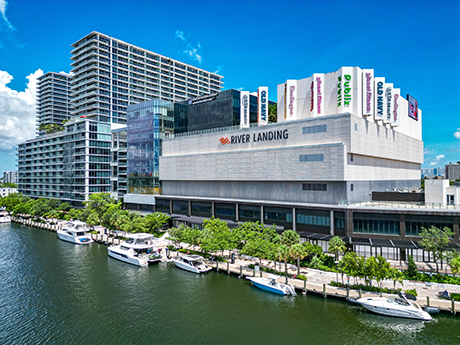
Midway Sports recently opened at River Landing Shops & Residences, a mixed-use development along the Miami River owned by H&R REIT and developed by Urban-X Group. The property includes a 345,000-square-foot, open-air shopping center.
“We’re quickly becoming a financial capital,” states Andrew Hellinger, principal at Urban-X Group and developer of River Landing Shops & Residences, a 2.6 million-square-foot mixed-use district in Miami. This is evidenced by firms including Citadel, Wells Fargo, Goldman Sachs and JPMorgan Chase relocating or expanding their office footprint, especially in South Florida.
Sprawling 1,000 feet along the Miami River, River Landing Shops & Residences opened in 2020 and features 341,741 square feet of retail and restaurants; 149,178 square feet of office space; 528 apartment units across two towers; more than 2,000 parking spaces; a riverfront park; and green spaces. Major tenants include Publix, T.J. Maxx, Ross Dress for Less, Hobby Lobby, Ulta Beauty, Five Below, Planet Fitness, CKO Kickboxing and Chase Bank, along with restaurants such as P. Pole Pizza, Lime Fresh Mexican Grill, Carrot Express, Häagen-Dazs and Chick-fil-A.
Midway Sports, a Miami-based specialty sports goods boutique, recently opened a 5,809-square-foot store to join the open-air center’s tenant lineup, which comes on the heels of River Landing’s second consecutive “Best of Miami” win and back-to-back honors in the Miami Herald’s “Miami-Dade Favorites” readers’ poll.
“Everything you need is here — it’s at your fingertips,” continues Hellinger. “River Landing is a catalyst for neighborhood investment because we can make a better community here without displacing people, and I think we’ve proven it’s possible.”
River Landing drew 6.9 million visitors in 2025 — a number that has increased every year since the development’s opening. That sustained foot traffic, coupled with South Florida’s rapid population growth, is reshaping retailers’ expansion strategies.
Brands that once bypassed the Miami market are now taking notice, including Japanese apparel retailer Uniqlo, which recently announced plans for its first two South Florida locations in Miami Beach and Aventura.
“The population growth has highlighted retailers, like Uniqlo, that weren’t originally considering coming here, but they’re opening two stores because it has been recognized as a place that people are flocking to,” says Hellinger.
However, Hellinger emphasized that the stores are not always as important as the environment in which the center thrives. He particularly pointed out that River Landing aims to be stress-free with its wide-open areas, tall trees, Florida breeze and easy parking.
“We’re educating people about what we are and what we’ve created, and the more we educate them, the more people come here,” he says.
Following the Tenant
Population growth and tourism may create the demand, but retailers ultimately determine how that demand takes shape. The retailers expanding across Florida today offer a snapshot of changing consumer priorities. While apparel, dining and entertainment remain important drivers of foot traffic, much of the state’s leasing activity is centered on concepts that combine convenience, value and experience.
For example, discount and off-price retailers continue to be among the most active tenants as consumers remain more cost-conscious, as high inflation, uneven job growth and rising household costs force consumers to become more selective in how they spend their money.
Chains such as Ross Dress for Less, Burlington, Marshalls, T.J. Maxx, HomeGoods and Five Below have become especially attractive because they offer shoppers a treasure hunt experience. Along with discount retailers, grocery stores and quick-service restaurants are also expanding aggressively in multiple Florida markets, a trend that is extending beyond leasing activity and into investor demand.
“We’re seeing the strongest buyer demand for lower-rent, lower-price-point assets, trophy locations and properties backed by strong credit tenants,” says Don McMinn, senior managing director of investments at Marcus & Millichap’s Taylor McMinn Retail Group. “QSRs, convenience stores and dollar stores remain among the most sought-after categories from investors.”
Discount grocer Aldi is actively converting dozens of former Winn-Dixie and Harveys Supermarket locations across the Southeast following its 2024 acquisition of Southeastern Grocers, now known as The Winn-Dixie Co. Close to 90 converted stores have reopened, while Aldi plans to steadily open dozens more of the acquired sites through the remainder of 2026 and into 2027.
At the same time, Publix continues to anchor neighborhood shopping centers, while specialty stores like Sprouts Farmers Market, Whole Foods Market and Trader Joe’s are expanding in markets with growing populations and higher household incomes.
“Retailers look for people. They want to go where the people are going and where they’re going to spend their money,” says Carrie Smith, executive vice president of Tampa-based Franklin Street. “There’s no question that that has played one of the largest roles in seeing concepts move or expand in the state.”
Miskew of Southeast Centers explains that although grocery retail hasn’t changed much over the years, there’s still more willingness among discount, premium and boutique grocers to chase optimal spots. Over its 45-year history, Southeast Centers has developed dozens of retail properties explicitly built around supermarket anchors, with roughly 29 of its developed shopping centers anchored by Publix.
Josh Beyer, senior vice president of development at Sembler Co., supported Miskew’s statement, reiterating that established, well-positioned grocery-anchored shopping centers continue to be the “gold standard” for retail property investors.
“Development has always been about more than building shopping centers for us. It’s about understanding where communities are headed, listening to what they need as they grow and building spaces that strengthen the neighborhoods our projects serve,” says Beyer.
Among Sembler’s active projects is West Port Marketplace, a Publix-anchored neighborhood shopping center in Port Charlotte that began construction in June. Positioned to serve the rapidly growing West Port community, the project is planned for delivery in the fourth quarter of 2027.
The company’s pipeline also includes Gateway Marketplace and Creekside Marketplace in Fort Myers. Together, the projects represent nearly 500,000 square feet of planned retail, grocery, home improvement, medical office, restaurants and everyday services along the growing Daniels Parkway corridor in Southwest Florida.
“Although grocery-anchored centers continue to be highly desirable for most retailers, I’m also seeing mixed-use product take shape,” adds Miskew. “Experiential placemaking has become the name of the game, which is great not only for the consumer, but for the investor, too.”
The uptick in mixed-use projects has persuaded landlords to not only fill a vacant storefront, but to assemble complimentary blends of retailers that are designed to keep consumers on-site longer and encourage repeat visits, reinforcing Florida’s strong retail reputation.
The Evolving Mixed-Use Center
The most successful retail projects in Florida are no longer asking consumers to make a shopping trip but instead are giving them multiple reasons to stay.
While there’s no doubt that mixed-use developments have become a defining feature of Florida’s retail landscape, the transformation has reflected a broader shift in how both retailers and consumers view shopping destinations.
“Developers are really looking at what’s going to keep people at the shopping center longer and how to get them to come back more frequently,” emphasizes Smith. “It’s no longer just about the anchor — it’s about the concept that’s going to drive foot traffic into the center.”
For instance, quick-service and fast-casual concepts, coffee shops and chef-driven local restaurants are filling new developments from Miami to Pensacola. Brands including Chick-fil-A, Raising Cane’s, Cava, First Watch and Dutch Bros Coffee have also continued their Florida expansion, while food halls and waterfront dining destinations are becoming a trademark for these neighborhoods.
The importance of an anchor has not diminished, but the definition of what drives traffic has evolved. The new generation of mixed-use developments offer a built-in customer base of residents, employees and/or visitors, creating steady foot traffic throughout the day and reducing retailers’ reliance on traditional peak shopping hours.
In addition, as hybrid work schedules and changing lifestyles reshape daily routines, shoppers are placing greater value on environments where they can accomplish multiple tasks in a single trip — whether that’s grabbing coffee, attending a fitness class, shopping for groceries or dining with friends.
That strategy is unfolding at Miami Worldcenter, a $6 billion mixed-use development in downtown Miami’s Park West neighborhood. The project, which was led by managing partners Art Falcone and Nitin Motwani along with Los Angeles-based investment firm CIM Group, spans 27 acres across 10 city blocks with 100,000 square feet of new public space; 300,000 square feet of retail, restaurant and entertainment space; 16 high-rise towers for residential and hospitality uses; and World Square, a 20,000-square-foot outdoor public plaza and park that serves as the centerpiece of the development.
Miami Worldcenter’s street-level shops opened to the public in May 2025 and include brands such as Apple, Sephora, lululemon, Lucky Strike Bowling, Savage x Fenty, Ray-Ban, Free People, The Container Store, Posman Books, Lucid Motors, HŸP Sneakers & Streetwear and The Spot Barbershop, among others. The restaurant lineup includes Brasserie Laurel, El Vecino Cigar & Cocktail Bar, Maple & Ash, etta, Sixty Vines, Earls Kitchen + Bar, Chugs Express, Sweet Paris Crêperie & Café and Starbucks Coffee. This February, luxury watch and fine jewelry boutique Timeluxe opened its 4,900-square-foot flagship store at the property.
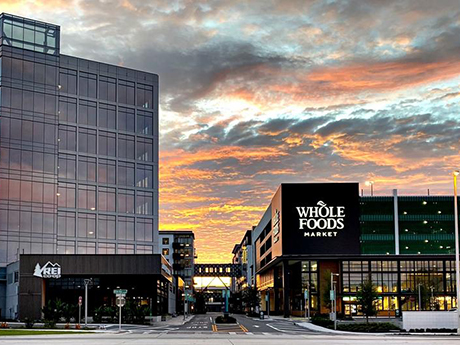
Midtown Tampa, a 1.8 million-square-foot mixed-use district located in Tampa, Florida, recently welcomed Pura Vida Miami, CorePower Yoga and The Shade Store to the property.
Midtown Tampa, a 1.8 million-square-foot live-work-play destination, offers another example how mixed development is reshaping retail strategy. Comprising roughly 22 acres, the $500 million project features 700,000 square feet of office space; Novel Midtown Tampa, a 390-unit apartment complex; a dual-branded Marriott hotel that features the Aloft and Element brands; more than 200,000 square feet of retail space; and a 3-acre lake and recreational trail. Some tenants include Whole Foods Market, Squeeze Massage, Corepower Yoga, REI, Shake Shack, Kale Me Crazy, Sephora, True Food Kitchen and F45 Training. Opened in March 2021 and developed by New York-based Bromley, the center bridges downtown Tampa with the Westshore Business District.
Developed by NDT Development, Place Projects and Wheelock Street Capital, West Palm Beach’s Nora District adds to the collection of creativity in Florida. The $1 billion mixed-use project is transforming a collection of historic warehouse buildings into a walkable neighborhood of restaurants, boutiques, fitness concepts and offices, while illustrating how adaptive reuses can create a distinctive sense of place while preserving local character.
Phase I of Nora District, which comprises 150,000 square feet of retail, office and hospitality space, was delivered in October 2025. Tenants include fine jewelry retailer LUCE; women’s fashion retailer Pompanos Boutique; group fitness gym studio SWEAT440; eyewear brand Warby Parker; along with Loco Taqueria & Oyster Bar, H&H Bagels, Van Leeuwen Ice Cream, Juliana’s Pizza, IGK Hair Salon and Le Labo. The project is expected to be fully completed by late 2029.
In Central Florida, Lake Nona Town Center demonstrates how mixed-use retail can evolve alongside a master-planned community. Surrounded by residential neighborhoods, medical facilities, educational institutions and technology employers, the 4 million-square-foot property has attracted an innovative tenant mix that reflects the area’s growing population and professional workforce. Key components of the development include the Lake Nona Wave Hotel; Lake Nona Performance Club, a wellness and fitness complex integrated with local medical and sports science initiatives; Boxi Park, an open-air entertainment venue built using repurposed shipping containers that features food trucks, live music and volleyball courts; as well as restaurants like Chroma Modern Bar + Kitchen, Park Pizza & Brewing Co., and Bosphorous Turkish Cuisine.
Also within the Lake Nona campus, Lake Nona West, a 405,000-square-foot daily-needs retail hub, is underway. Target officially opened in July, while additional retailers joining the development will include Drybar, Just Salad, Gloss Nail Co., Kilwins Ice Cream, Homesense, Barnes & Noble, Dick’s Sporting Goods, Golf Galaxy, Total Wine & More, JETSET Pilates, Nordstrom Rack, Sephora and Canonita, a Mexican restaurant.
Both Lake Nona Town Center and Lake Nona West, which function as distinct commercial anchors on opposite ends of Lake Nona Boulevard, were conceived and built by Tavistock Development Co.
Retail Finds Its Community
If Lake Nona represents the future of innovation-driven retail, then The Villages demonstrates the enduring power of lifestyle-driven retail. What began as a retirement community in Central Florida has transformed into one of the nation’s fastest-growing master-planned developments and, in many ways, one of Florida’s most unique retail ecosystems. The Villages has cultivated a ready-made market that is highly engaged, socially active and loyal to the businesses that serve it.
“A typical lifestyle center has to have the co-tenancy to drive the crowd in — but we already have that crowd,” says Geno Jarquin, executive director of commercial development at The Villages.
The Villages sits between I-75 and the Florida Turnpike, about 30 miles north of downtown Orlando and about 45 miles northeast of the Tampa MSA.
Unlike many communities where retail is expected to compete for occasional visits, The Villages was designed to make shopping, dining and entertainment part of everyday life. Residents travel by golf cart to restaurants, grocery stores, boutiques and town squares that host nightly live music and community events that creates a steady flow of foot traffic from morning until well after sunset.
That consistent activity has made the development an attractive destination for both national retailers seeking dependable sales volumes and local operators looking to establish themselves in one of the state’s most affluent and active consumer markets.
“Every day is a Saturday night for us. We have a high-wealth population, coupled with the time and desire to spend that wealth, and that is something that we find is truly unique to The Villages that you don’t normally find in your typical urban markets,” explains Jarquin.
The nearly 8 million square feet of commercial space in The Villages is broken down across three main types of properties: town centers, neighborhood shopping centers and professional/medical plazas.
The heart of the community’s retail footprint is divided among its major mixed-use lifestyle hubs, which span between 400,000 to 500,000 square feet. The Villages also features 15 neighborhood shopping plazas and more than a dozen grocery stores, including eight Publix-anchored centers, alongside Sprouts Farmers Market, Aldi, The Fresh Market and Winn-Dixie. The remaining square footage includes 17 specialized professional plazas that house service-oriented tenants like medical practices, a 99,000-square-foot Veterans Affairs (VA) Outpatient Clinic, dental centers, insurance providers and regional banking hubs like Citizens First Bank.
Jarquin says that the 60,000-acre development’s retail component has been operating at close to 98 percent occupancy for years, while raking in approximately $1.5 billion in annual retail sales.
Part of what distinguishes The Villages is not the strength of its consumer base, but the culture it has cultivated around its businesses. Jarquin emphasizes that retailers are welcomed as partners in the community, with every new opening celebrated through a ribbon-cutting ceremony that introduces businesses to residents and reinforces their place within the development.
“We’re a family company and we take great pride in all of our shopping centers, so we want to make sure that when someone comes in, they do well from the beginning, and we believe it’s our responsibility to provide that.”
Some tenants that have opened up within the past year at The Villages are Portillo’s, J. Jill, Club Pilates, Hand & Stone Massage and Facial Spa, Lucky Goat Coffee, Great Clips, Heartland Dental, Jeff’s Bagel Run, Zunzibar and Jersey Mike’s Subs.
While not a master-planned community like Lake Nona and The Villages, Miami Beach’s Lincoln Road retail district provides a prime example of how the relationship between consumers and retail destinations continues to evolve. Unlike traditional shopping centers designed primarily around convenience, Lincoln Road has positioned itself as an experiential retail strip where shopping, dining, entertainment and hospitality intersect.
Following Comras Co.’s revitalization of Lincoln Road in the early 2000s, which sold for $370 million in September 2015, the company now plans to transform Miami Beach’s next chapter of retail into a pedestrian-driven, micro-district called NoLi. In order to bring NoLi to life, Comras Co. acquired five buildings in late 2025 along Lincoln Road and North Lincoln Lane for $130.8 million.
Spanning more than 150,000 square feet, the project will bring together approximately 40 cafés, specialty shops, lifestyle concepts and office spaces across 1,800 linear feet of storefronts. NoLi will reuse the existing buildings and repurpose the outdated floorplans to create boutique-sized spaces, with layouts ranging in size from 400 to 4,000 square feet. Interior demolition of NoLi began earlier this year, and project completion is anticipated by the fourth quarter of 2027.
Michael Comras, president and CEO of The Comras Co., notes that this approach not only preserves the neighborhood’s character, but also creates a highly sustainable, walkable environment.
“As Miami continues to densify, retail is becoming more localized and community-driven, with growing demand for spaces that bring people together,” he says.
The micro-district has also introduced Via NoLi, a shaded, 18-foot-wide pedestrian paseo that serves as a “street off the street” and a third space for neighborhood gathering.
Along with a mix of anchor tenants and independent concepts, Lincoln Road has welcomed new brands to the market, such as Alo Yoga and the previously mentioned Uniqlo, while legacy retailers are relocating along Lincoln Road or rightsizing their stores to reflect the current market.
For example, Comras shared that Victoria’s Secret has recently relocated its 10,000-square-foot store to a 7,500-square-foot space, with reports of stronger sales in the smaller retail suite.
As Lincoln Road enters its most transformational era yet, the City of Miami Beach is leading a $29 million renovation of Lincoln Road that includes upgraded sidewalks, lighting, landscaping and new outdoor seating that will extend the pedestrian experience along Drexel and Meridian avenues.
This city-led improvement coincides with major private investments reshaping the neighborhood. Highlights include the restoration of the iconic Shore Club Hotel, soon to debut under the Auberge Resorts Collection; the Raleigh Hotel restoration; and the Grand Hyatt Miami Beach Convention Center Hotel, a new 800-room property slated to open in 2027 with direct skybridge access to the convention center.
Retail Reaches Further
While sources interviewed for this story highlighted the explosive growth of retail in the Sunshine State, they particularly noted that it’s not just staying in suburban hubs around Orlando and Miami anymore — it’s shifting outward.
As population stretches beyond the state’s largest metropolitan areas, retailers are increasingly targeting secondary and tertiary investment.
Miskew notes that as the coastlines have grown and become saturated, retail and commercial growth are expanding heavily into major inland corridors.
“We’re seeing markets that were originally slower to take shape are now exploding.”
According to U-Haul’s “2026 Midyear Migration Trends” report, Gainesville ranked as the No. 1 metro destination for Baby Boomers, while Fort Myers claimed the top spot among Gen-X movers, underscoring the broad appeal of Florida’s growing markets across multiple age groups.
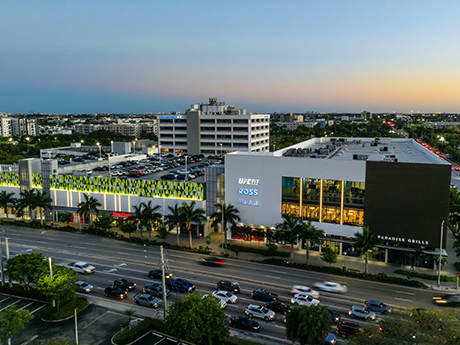
IMC Equity Group recently purchased Doral Square, a 150,000-square-foot lifestyle retail center in metro Miami, for $74 million. The property is anchored by Marshalls, Ross Dress for Less, UFC Gym, HomeGoods, Pet Supermarket and One Medical.
That influx of residents has helped sustain favorable supply-and-demand dynamics across many of Florida’s top retail markets, where tenant demand continues to outpace new construction, keeping vacancies low and competition for well-located space high.
Matthews reported that Orlando entered the new year posting a 15 percent increase in leasing activity alongside roughly 5.5 percent rent growth. On top of that, Tampa Bay’s asking rent rose to $27.53 per square foot at the end of the second quarter, representing a 2.8 percent year-over-year increase, according to Cushman & Wakefield’s “Q2 Marketbeat Retail Report.” This region has ranked second in the top U.S. markets for rent growth in the past 10 years, with rates climbing over 71.6 percent during that time.
In Northeast Florida, Colliers’ second-quarter retail overview reported that Jacksonville documented a modest 2 percent annual rent growth, and Southwest Florida is maintaining vacancy near 3.5 percent as service-oriented and experiential retailers absorb new space. Together, those metrics illustrate that retail growth is no longer concentrated in one or two gateway markets, and that Florida’s retail momentum is evident across every corner of the state.
“It’s been great to see that the retailers and restaurants coming into the state are continuing to invest and are spreading out, where it’s not so densely concentrated in South Florida like it used to be,” says Smith of Franklin Street.
For example, Florida’s Space Coast, a region along the Atlantic Coast that has long been tethered to the aerospace and defense industries, is attracting a growing concentration of technology and engineering professionals. Barron Collier Investment Partners (BCIP) recently acquired nearly 33 acres to develop The Landing at Space Coast, a planned mixed-use project that will include approximately 77,750 square feet of retail space anchored by a grocery store, along with restaurant and service-oriented tenants and 300 residential apartments.
In addition, Port St. Lucie, once a slow-building retiree and commuter expanse in southeast Florida, is now one of the state’s fastest growing municipal markets. The growth is translating directly into retail investment, specifically within the city’s Tradition master-planned community. Developments such as The Shoppes at the Heart of Tradition, a 71,000-square-foot, Aldi-anchored center that sold for $32 million in 2025, are highlighting the increasing demand for neighborhood-serving retail in places that previously saw limited commercial construction.
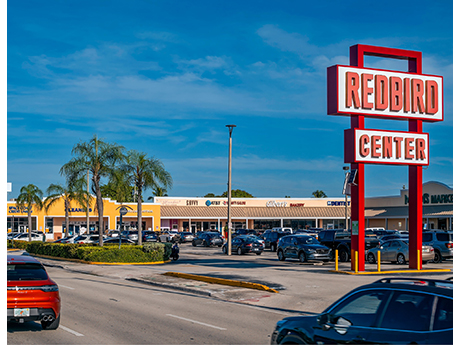
Asana Partners recently acquired Red Bird Center, a 92,089-square-foot shopping center in Miami anchored by Milam’s Markets.
As this growth expands in new markets, investors are responding with an equally broad appetite for acquisitions across the state. Recent activity includes Asana Partners’ $62 million purchase of Miami’s historic Red Bird Center, a 92,000-square-foot grocery-anchored neighborhood center; IMC Equity Group’s $74 million acquisition of Doral Square, a 150,000-square-foot lifestyle center that’s anchored by Marshalls, Ross Dress for Less and UFC Gym; Hammock Landing, a 750,000-square-foot retail power center in West Melbourne sold by CBL Properties and The Benchmark Group for $78.5 million; and the $86.3 million sale of a six-property shopping center portfolio totaling 184,680 square feet in Jacksonville.
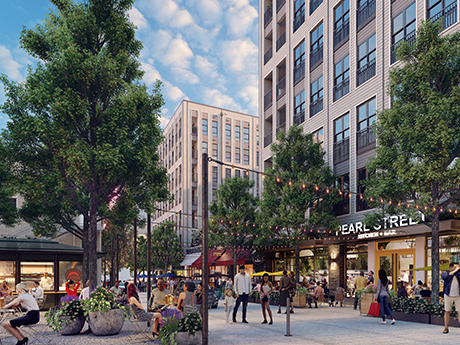
One of the most anticipated developments in the NorthCore district of downtown Jacksonville is Pearl Square. Headed by developer Gateway Jax, the $1 billion project is transforming approximately nine city blocks into a walkable neighborhood featuring residential living, retail, dining and green spaces, which will extend activity beyond the city’s traditional commercial core.
Anchored by Publix, the 2 million-square-foot project is moving forward with plans for a six-story office building that will sit alongside 1,250 apartments and more than a dozen restaurants and shops. Five additional buildings, including a hotel redevelopment, are under construction. The first residential building — The Vandeveer — is slated to open this fall with retail tenants like Buchner’s Biergarten and JETSET Pilates on the ground level.
Meanwhile, in Central Florida, Sutton Properties is planning a Mattel-themed entertainment center, which will bring immersive, brand-driven entertainment to the Lake Buena Vista tourism corridor.
“Experiential retail has really been a powerful trend in our industry,” says Sam Sutton, president of Sutton Properties and developer of Lake Buena Vista Resort Village & Spa, a 500-unit luxury condominium hotel and outlet center near Walt Disney World Resort.
Sutton’s newest project will include the Mattel Wonder Indoor Waterpark and will feature roughly 150,000 square feet of indoor water attractions, a retractable roof, wave pools and branding tied to Barbie and Hot Wheels.
The investment also reflects Sutton Properties’ belief that Florida’s lifestyle continues to fuel demand for destination-oriented developments.
“Florida appeals to people who want to enjoy life, whether they’re young or old.”
Growth Isn’t Without Growing Pains
The same factors fueling the state’s expansion — rapid population gains, heightened retailer demand and an active development pipeline — have also intensified competition for financing and labor. As developers race to keep pace with demand, they are increasingly navigating a landscape shaped by rising construction costs, limited site availability, infrastructure constraints and a financing environment that remains far more selective than just a few years ago.
“Every time we begin to see a leveling out of construction costs, there’s something new that happens macroeconomically that, once again, affects construction costs,” explains Smith of Franklin Street. “It impacts our team’s ability to make deals, impacts landlords being able to get deals across the finish line and it certainly impacts the retailers and restaurants.”
Smith notes that before the pandemic, there were certain tenant improvement (TI) dollars that you could expect out of a deal, but now things have changed — every deal is vastly different.
“Retailers are currently looking for partners in their business — they want to go to a shopping center that has a landlord who’s willing to invest,” she says. “It’s no longer siloed, and we’re figuring out how to make this proactive on both sides.”
However, perhaps the clearest indicator of Florida’s long-term retail outlook isn’t found in any single development or transaction, but in the market’s ability to continually create new opportunities. Even as economic factors continue to test the boundaries of the market, the state’s underlying demand has consistently given developers, retailers and investors reason to keep building, leasing and investing.
— Abby Cox
This article was originally published in the August 2026 issue of Shopping Center Business magazine.