

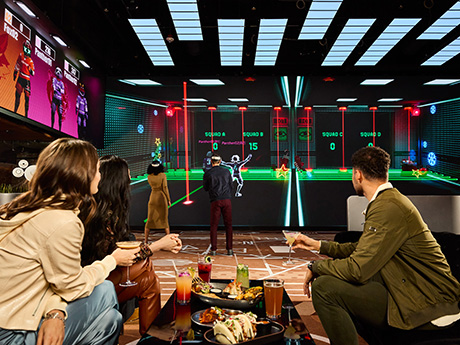
Some things about entertainment never change.
“Customers want variety, value and a reason to return,” says T.J. Schier, CEO and founder of indoor golf driving range experience Smash Swing.
What has changed is how difficult it is to deliver all three at once. Get the balance wrong, and sales, reputation and loyalty suffer. Get it right, and the concept may not just survive this high-cost, high-stakes atmosphere, but cement itself as a true destination. One landlords clamor for.
Variety: From Single-Attraction to Social Destination
In today’s day and age, Schier believes there’s one key strategy that can set concepts up for success early on: diversification.
“Many concepts are ‘single attraction’ and struggle on a couple of fronts,” he explains. “They can suffer from low return rates — since the attraction doesn’t change, the return visits are infrequent — and value since food and beverage is often overbuilt, over-engineered menus so they charge higher prices for food and drinks.”
The result? A lack of loyal customers and a lack of perceived value.
Instead, Schier recommends focusing on the three sequential areas.
“The attractions — they are the highest margin — then drinks, then food,” he continues. “Concepts need to understand that.”
Sam Wang, co-founder of social virtual reality (VR) arena Mirra Immersive, varies his offerings by introducing seasonal programming. This may include a Halloween ghost-battle game, a holiday season team-collection game, a summer fishing competition or a soccer game tied to the World Cup coming to the U.S.
“Same arena, different experiences,” he adds. “That’s how we drive refreshes and repeat visits without rebuilding the concept.”
Pieter Martens, founder and CEO of timed social gaming adventure Time Mission, notes that what “variety” looks like — and what customers expect from it — can shift depending on where the concept is situated.
“Customer behavior for Time Mission is highly location-driven,” he says.
If the concept is in a mall environment with a strong concentration of kid-focused attractions, for example, the median age for Time Mission skews younger, to around 16. If it’s based in multi-concept family entertainment centers with more adult-oriented activities, the median age rises to the low 20s. Meanwhile, in downtown Philadelphia, the strongest segment is young professionals with peak demand in the 20 to 40 age range, Martens adds.
Antonio Nieves, founder of inflatable park experience FUNBOX, further notes that there’s a difference between variety for variety’s sake and variety that actually builds value and loyalty. He believes there’s also something to be said for predictability, at least with certain consumer cohorts.
“Our core demographic is neighborhood parents and children, and they respond best to clear structure,” he says. “Rather than constant novelty, families value knowing what’s happening on specific days and times. Consistency builds trust and makes visits easier to plan.”
For those reasons, FUNBOX emphasizes recurring weekday offerings, including toddler-focused sessions that parents can rely on week after week.
“These programs create rhythm for families while improving utilization during slower dayparts,” Nieves explains. “The experience feels intentional rather than promotional.”
One program that’s performed especially well is GlowZone nights, which happens on Friday evenings at FUNBOX’s Arcadia, California, location. Nieves notes this event attracts a completely different audience than it normally pulls during standard hours: about 80 to 100 teens arriving without parents or younger children.
“Predictable programming allowed us to expand our audience without altering the core concept,” he adds. “It’s a clear example of how structured experiences can drive repeat visits and extend operating potential.”
Wang notes there’s another way to expand a concept’s audience. Oftentimes, those people are already in the building.
“The biggest behavior we’re seeing is that guests don’t just want to play,” he explains. “They want to watch, react and feel part of the show. That’s changing how we design the experience.”
Yes, the spectator has entered the arena. Or, more accurately, the establishment.
“Spectators aren’t passive — they’re emotionally active,” Wang continues. “Large groups stay fully engaged even when their friends are on the arena floor. Crowd energy matters as much as gameplay. That behavior is shaping Mirra into a platform built around collective immersion, not individual play.”
Plus, spectators are already on-site, so why wouldn’t you sell to them?
Schier thinks you should.
“You serve two distinct customers: the players and the spectators,” he says. “So many brands miss the ‘spectator’ part. Sitting in a bowling lane, watching laser tag or someone throw darts, hit a golf ball, etcetera. What is their experience like? What are they seeing or feeling? Too many miss this point.”
Another point they miss, argues Mathew Focht, founding managing partner of Emerging, the experiential leisure group behind social entertainment concepts like F1 Arcade, Flight Club and BatBox, is the value of monetization through layering. After all, this strategy can target everyone in the building, whether they’re in the “arena” or not.
“Operators are getting smarter about add-ons, such as premium formats, private bookings, food and beverage upgrades and brand-relevant merchandise,” he says. “Rather than simply raising prices, the most successful concepts are increasing perceived value by giving guests more control over how they experience the venue.”
Value: Perceived Worth > Price
Variety — whatever form that takes — may get customers into the door, but value determines whether they stay. And whether they return.
Right now, it’s under a microscope.
“Value remains a central driver, whether expressed through priceconscious retail or through experiences that feel worth the trip,” says Philip Voorhees, partner at Bison Partners. “The concepts that execute well have a clear value proposition and a deep understanding of their customer. I believe Warren Buffett said, ‘Price is what you pay. Value is what you get.’”
Voorhees notes the strongest operators deliver value across the spectrum, regardless of whether they’re a valuefocused retailer that thrives on price or a premium experiential concept where customers willingly pay for quality, ambiance and service.
He also knows many operators are fighting an uphill battle against expenses themselves.
“The biggest challenge is cost,” Voorhees continues, noting the heavy occupancy burden today’s concepts face.
Between rising construction costs, higher base rents and escalating triple-net costs, the margin for error has narrowed significantly. Voorhees notes that a tenant paying $72 per square foot in base rent, plus $28 per square foot in triple net faces a total cost of $100 per square foot a year. At that level, the math gets unforgiving.
“To keep occupancy costs below 8 percent, that tenant must generate $1,250 per square foot in annual sales, a threshold achievable only by the strongest [concepts],” he says.
That reality has sharpened how operators think about value. Simply being fun or novel isn’t enough anymore. Experiences must justify the trip, the spend and the time commitment in a way guests immediately understand.
That’s where execution matters.
As Schier alluded to, value breaks down quickly once food and beverage begins to overshadow the attraction itself.
“People don’t order more upscale items frequently in places like these,” he says. “Rather, they opt for known, low-risk items like burgers and wings.”
Some operators have found that value can be achieved for both the concept and customer through bundling.
“Private customers are increasingly choosing one- to two-hour activities that naturally combine gameplay with good food and drinks,” says Eliran Farhi, CEO of immersive basketball entertainment center Neoja. “We see more weekend groups asking for a full ‘play-and-dine’ experience as a single package.”
Of course, value isn’t just about price or packaging. It’s about fit.
“Experiential concepts are dynamic by nature, and no two days — or guests — are the same,” Nieves says. “The hardest thing to replicate…is human emotion in a live environment.”
Yet hard is not impossible.
“Success starts with alignment,” Voorhees says. “The concept must resonate with both the demographic and psychographic profile of the trade area, and it must deliver a value proposition strong enough to merit repeat visits.”
Loyalty: Turning Occasional Guests into Regulars
Farhi has seen the impact a concept can have when it delivers variety and value.
“The impact is clear: repeat visitors engage more, stay longer and are more likely to bring friends because they know they will not get the exact same experience twice,” he says. “The biggest driver of satisfaction is that returning guests always feel something is new, either in the environment or in the games themselves.”
Guests can also return to “finish” what they started, Martens argues.
“Time Mission is intentionally designed so guests can’t do everything in a single visit,” he says. “That alone drives repeat behavior.”
The concept also operates on a centralized scoring system, which encourages teams to return and improve their performance over time. So far, it seems to be working with guests.
“Guest satisfaction remains consistently high, with ratings ranging from 4.9 to 5.0 stars across our locations,” Martens continues. “That shows up most clearly in qualitative feedback. People describe it as a ‘real-life Mario Party’-style mix of quick, varied challenges — and many say they want to come back to beat their score or hit rooms they missed.”
Craig Winning, COO of interactive baseball experience BatBox, also leans heavily on customer feedback — particularly at its Addison, Texas, location — to better understand what brings guests in, and what keeps them coming back.
So far, this has resulted in key improvements, including a more seamless booking and check-in flow, upgraded and more engaging game experiences, and stronger user data capture to personalize and improve gameplay over time.
“The clearest behavioral signal has been repeated visitation,” Winning says. “We’re bucking typical industry norms, with guests returning at higher rates and staying engaged longer.”
BatBox’s technology-first platform also allows him to introduce new games, features and experience enhancements in a modular way.
“Our refresh cadence is quarterly, enabling us to consistently deliver new content while keeping operations stable,” he says.
BatBox sessions average about 88 minutes, “reflecting strong utilization and deep guest immersion.”
Speaking of immersion, licensed intellectual property (IP) can be a great investment, adds Howard Samuels, president and CEO of Samuels & Co. Rather than rebuilding concepts from the ground up, integrating recognizable IP allows venues to introduce new content layers that feel familiar, timely and unique, all without making any physical changes or upgrades to a space or concept.
“Refreshing [now centers around] the newest or latest technology applications,” he says. “Cross-marketing with ‘real’ IP like Minecraft also helps concepts maintain market share.”
Schier notes that Smash Swing is focused on bringing a steady stream of new games and seasonal ones so the operators have “new news” to share with their customers, which drives frequency. But that’s not the only way to drive frequency.
“Memberships, all-you-can-play and packaged deals are pretty prevalent these days to drive traffic in these type facilities as well,” he adds.
Roxanne Klein, senior vice president of retail leasing and sales at California-based Progressive Real Estate Partners, also likes it when concepts can take competitive socializing to the next level. And by that, she means the next week. Week after week.
“For example, many golf simulator and pickleball concepts now focus heavily on leagues,” she says. “This transforms them from single-use destinations into community gathering spaces with strong recurring traffic.”
Corporate events and birthday parties can further introduce new visitors who may turn into repeat customers — as long as the experience is a good one.
“Corporate groups are actively looking for a fresh team experience that goes beyond a standard dinner — something interactive and memorable,” Farhi says.
Winning notes that families account for more than one-third of all BatBox gameplay users, while group event sales represent about 30 percent of total revenue.
Nieves has also found success in creating repeat business through group events like GlowZone.
“We’re now selling birthday parties during an 8 p.m. time slot that previously had little to no demand,” he says. “The energy is distinct, controlled and highly repeatable.”
It’s also highly Instagrammable, something Nieves believes is all but required nowadays to draw and keep a crowd.
“Social sharing has become a core expectation of the family entertainment experience,” he continues. “Parents now choose venues with the assumption that birthday parties and milestones will be shared on social media. That expectation increasingly influences where families decide to celebrate.”
With that in mind, FUNBOX spaces aim to feel intentional, visually clean and safe to post. That means lighting, flooring, wall finishes and color palettes are selected to film and photograph well in short-form formats like Reels and Stories. This allows FUNBOX to lean into the social media trend, subconsciously encouraging participants to post.
“We view this as a natural content engine rather than a marketing tactic,” Nieves explains. “When families are proud of the experience, content is created and shared through trusted social circles. That visibility consistently translates into real visits. Designing for shareable moments allows today’s memories to drive future demand.”
Concepts should also be designed to surprise and delight. FUNBOX, for example, asks parents to confirm their child’s favorite characters during the party planning process. At the end of the event, there are two surprises: the guest of honor receives an unexpected toy tied to their preference, while the parents receive a printed photo album featuring moments from the celebration.
“For the child, it’s a simple gesture, but it immediately makes the experience feel personal,” Nieves adds. “For moms and dads, it’s an unexpected keepsake that captures something parents rarely get: memories where they’re actually present in the moment.”
Vicky Hammond, managing principal at Coreland Companies, is a fan of this type of strategy.
“Demand is being shaped by the ‘Instagrammable’ nature of a concept,” she says. “Identifying ways to curate a range of moments creates an experience that cannot be duplicated online — a reason to enjoy a space with friends, and for longer periods of time.”
Naturally, shopping centers play a role in that, too. Wang prefers to choose locations that inherently function as gathering spaces.
“We perform best in environments where guests already arrive in a group mindset,” he says. “Shopping centers, cinemas, family entertainment centers and mixed-use destinations naturally support shared experiences, dwell time and social energy.”
Intentional placemaking also signals to entertainment concepts that this may be the place for them to grow alongside like-minded tenants.
“Experiential concepts, including golf simulators and axethrowing venues, are integrating seamlessly into these environments and continue to grow at a rapid pace,” Voorhees says. “[Los Angeles-based] retail projects like Federal Realty’s the Point in El Segundo and Manhattan Village in Manhattan Beach are standout examples of placemaking done exceptionally well, each offering a curated mix of national, regional and local tenants, along with food and beverage, retail and service offerings that encourage longer visits.”
Having a built-in audience can make a difference, especially if a concept is new to market, or just plain new. Like Wang, Nieves looks for centers that are established as default gathering places, rather than simple retail destination. He found this at both Bowie Town Center in Maryland and Natomas Place in Sacramento, California.
Bowie Town Center, Nieves notes, had a strong community rhythm, where families already lingered and socialized. Natomas Place, meanwhile, excelled as a “highly efficient neighborhood hub, where quick decisions turn into repeat visits.”
“That behavior matters more to us than raw traffic counts,” Nieves says. “It signals emotional ownership by the community. Both centers reinforce that success isn’t about being flashy — it’s about being usable.”
Martens agrees, noting that where the space sits inside a center can matter more than the center’s traffic stats.
“First, adjacency and visibility matter more than raw foot traffic,” he says. “While Time Mission is strong enough to act as a destination, performance improves significantly when we’re located near social decision points, such as food courts, dining clusters or other entertainment uses.”
Samuels believes there are two factors that can help determine whether a shopping center will be a good fit for an entertainment concept.
“Performance of existing leisure tenants like movie theaters, dining and health clubs that can provide empirical information on number of visitors, dwell time and repeat visitation,” he says. “The other is whether they have a clustering of concepts so customers can visit different attractions on various visits. When they do, it tends to become the premier destination spot for entertainment.”
That’s because these clusters create adjacency and synergy, Focht adds.
“Experiential concepts perform best when they’re surrounded by complementary food, beverage and social uses that extend dwell time,” he explains. “Because social entertainment isn’t a high-frequency visit, clustering similar or adjacent concepts doesn’t create cannibalization — in fact, it increases top-of-mind awareness.”
These clusters don’t have to be limited to entertainment concepts, either.
“The success of a tenant in any location relies on various factors, including whether a good tenant mix has been curated,” Hammond says. “Positioning an experiential tenant, such as the Picklr or Holey Moley, alongside great restaurant concepts strengthens everyone’s reach.”
A rising tide can indeed lift all boats, but you have to be in the water (center) to reap the rewards. Getting there is a hard enough challenge, but staying there is even more daunting.
“Operations are consistently under appreciated by most landlords,” Samuels adds. “Especially now that front- and back-of-house operations, marketing — including competitive social media — and personnel is more important than ever.”
But when it comes together, the results can be remarkable.
In an environment where customers still want the same fundamentals — variety, value and a reason to come back — the winners aren’t reinventing entertainment. Instead, they’re reconsidering execution, designing with more intent, and aligning more tightly with both their audience and their environment.
“The consistent lesson is that the tenants who succeed know exactly who they serve, why customers return and how to deliver an experience that justifies the cost structure of modern retail real estate,” Voorhees says.
Customers still want the same things. Only the bar for delivering them has changed. Oh, and the bar can’t be the main driver. The attraction has to stand strong on its own.
— Nellie Day
This article was originally published in the February 2026 issue of Shopping Center Business magazine.