

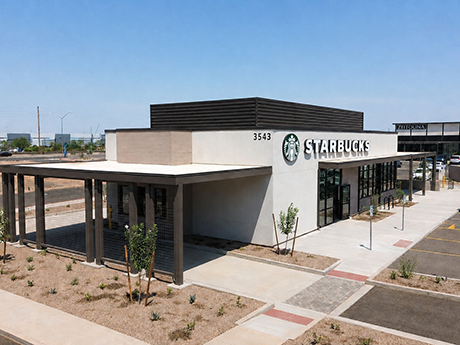
Coffee has become an increasingly active segment of retail real estate, driven by national brands continuing to expand and a business model built around one of the most consistent consumer behaviors: routine.

For developers and landlords, that growth means continued demand for well-positioned sites. For investors, it is creating a pipeline of coffee-occupied properties that can combine quality real estate, established operators and long-term contractual cash flow.
What connects the two is important. Many of the fundamentals that make a location attractive to a coffee operator at the beginning of the development process can ultimately help make the completed property attractive to an investor.
What Coffee Brands Want in a Location
Coffee site selection starts with the fundamentals familiar to any retail developer, including demographics, traffic counts, visibility and access. But the ability to capture consumers as they move through their daily routines is particularly important for coffee operators.
The morning commute and school drop-off are obvious examples, but coffee traffic extends throughout the day, from errands to meetings and other regular trips. The strongest locations are often those that naturally fit into those existing patterns rather than requiring consumers to go out of their way.
Surrounding uses also matter. A quality mix of retailers, restaurants and service-oriented businesses can create additional traffic throughout the day and strengthen the overall environment surrounding a coffee location.
Drive-thru potential can add another layer of convenience, particularly as brands continue refining formats around how customers want to use their stores.
We see these considerations playing out across Diversified Partners’ own portfolio. The firm currently works with approximately 10 coffee brands and has worked with more than 20 coffee-occupied properties, including locations involving Starbucks, Dutch Bros., Einstein Bros. Bagels and Black Rock Coffee Bar. More than 10 coffee locations are currently in development, including two under construction.
Repeat business with operators such as Starbucks and Dutch Bros. has also provided a firsthand look at how national brands evaluate sites as they expand.
When Site Fundamentals Become Investment Fundamentals
The importance of those decisions does not end when construction is complete and the doors open.
A site selected for its access, visibility, demographics and ability to generate consistent traffic carries those characteristics with it into the investment market. In that sense, the development and investment stories are closely connected.
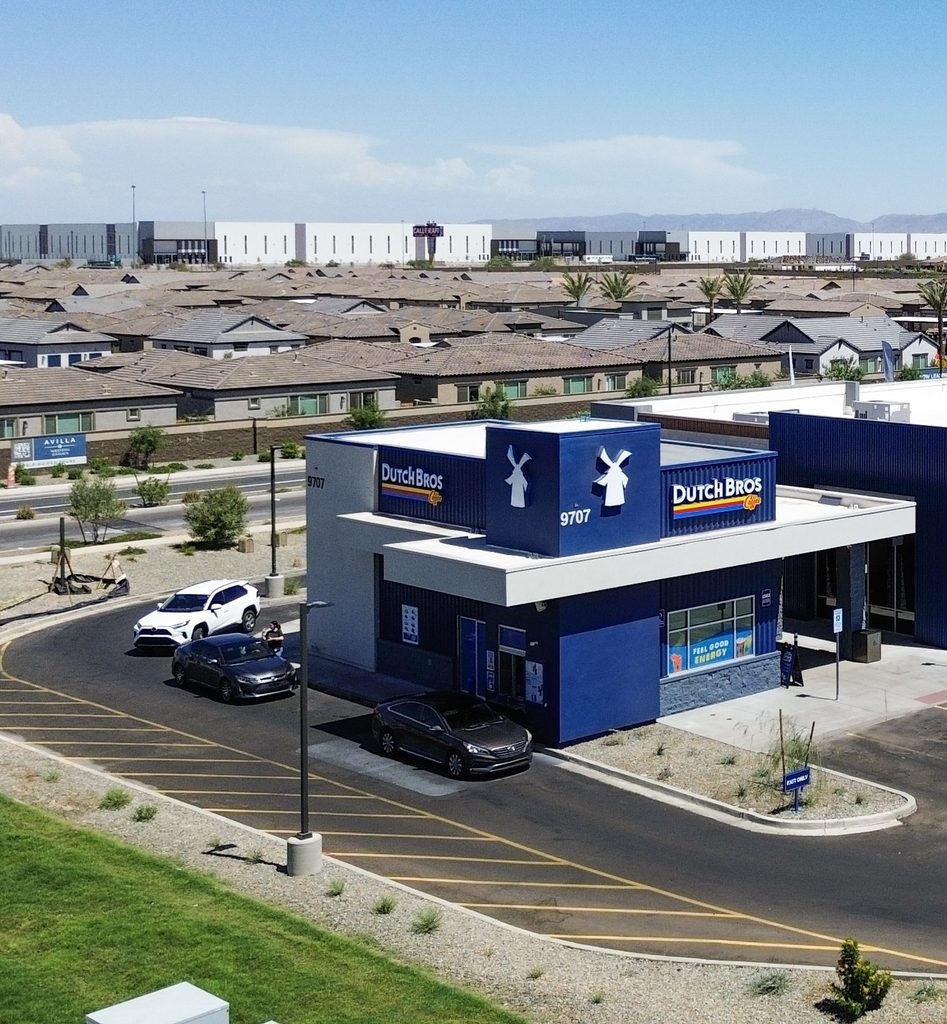
Coffee-related assets continue to generate interest in the single-tenant net-lease market because they can offer investors several characteristics they value, including strong underlying real estate, recurring consumer demand and long-term contractual income.
In our experience, coffee assets typically carry lease terms of 10 to 15 years. The high-frequency nature of the business can also support consistent repeat traffic and store-level performance, helping give investors confidence in both the underlying operation and a tenant’s ability to meet its rental obligations.
We are seeing that interest translate into activity. Diversified Partners currently has more than $20 million in coffee-related investment sales expected in its pipeline over the next 12 to 18 months, while engagement with the firm’s current coffee properties on the market provides another indication of investor interest in the category.
Of course, a coffee logo alone does not make a strong investment. Buyers still need to evaluate the individual property, including the quality of the location, tenant, lease structure, remaining lease term and surrounding trade area.
That is where decisions made much earlier in the real estate lifecycle become especially important.
Following the Full Real Estate Lifecycle
As coffee brands continue to grow, developers, landlords and investors have an opportunity to think about these properties as more than individual store openings.
A site may begin with an operator evaluating traffic patterns, demographics, access and surrounding tenants. Once developed and occupied, many of those same characteristics become part of the investment thesis for a potential buyer.
For those of us working across both sides of that process, the continued expansion of coffee brands reinforces a fundamental principle of retail real estate: Long-term value starts with getting the location right.
Consumer preferences and store formats will continue to evolve, but convenience, accessibility, strong surrounding uses and consistent traffic remain critical. When those fundamentals align with an operator that can become part of consumers’ daily routines, the result can be a property positioned to perform both as a retail location and, ultimately, as an investment asset.
— John K. Jackson, Senior Vice President of Investment Sales at Diversified Partners